What Is EBO2 (EBOO)? The Procedure, the Evidence, and What Regulators Say
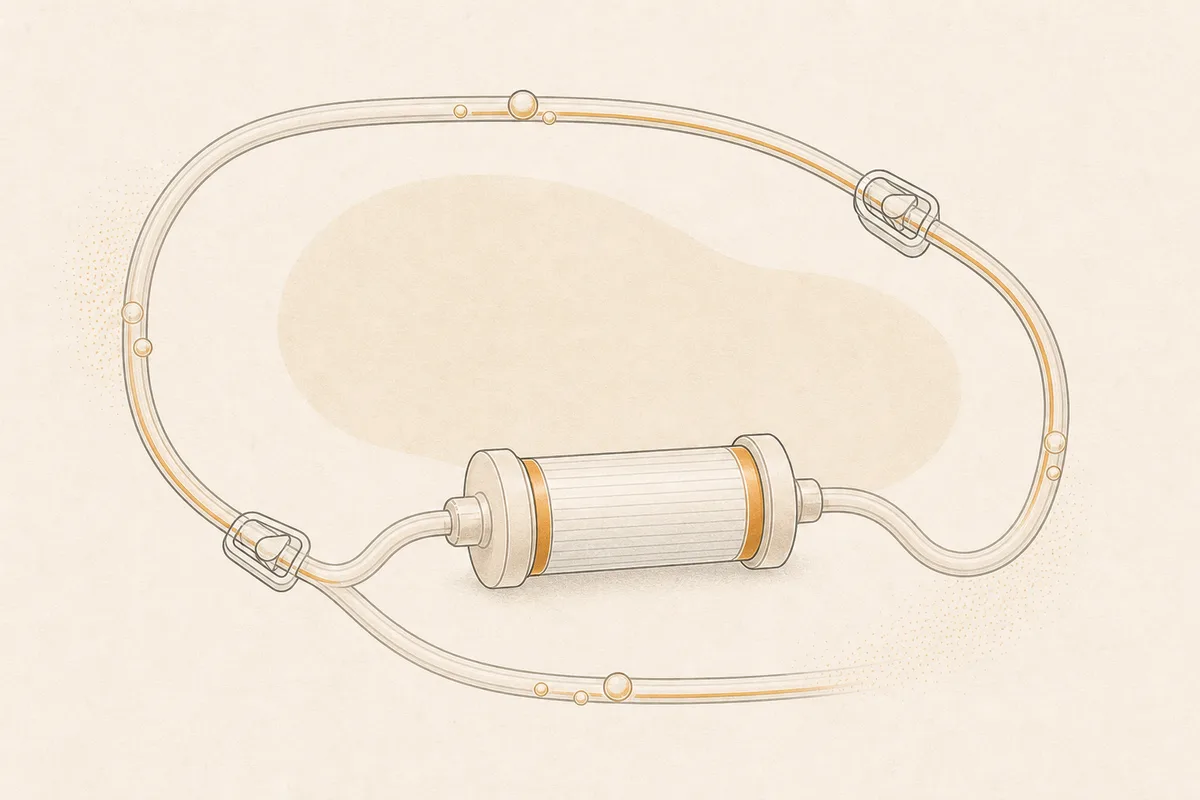
EBO2 (also called EBOO) stands for extracorporeal blood oxygenation and ozonation. Blood is pumped out of a vein in one arm, through a device where it meets a mixture of oxygen and ozone gas, and back into a vein in the other arm, continuously, for about an hour [1][2]. A nephrology group in Siena, Italy, built the apparatus over the 1990s and published the first human report in 2000 [3]. Ozone therapy is not FDA-approved for any condition, and the FDA’s device rules describe ozone as a toxic gas with no known useful medical application [4].
This page is for checking what a clinic tells you against the primary sources. It walks through the circuit as its developers and a US practitioner group described it, sets the version sold in US clinics beside the one in the Siena papers, compiles what clinic pages and regulators say, and ends with what is and is not established.
The short answer
- What it is. A blood circuit, not an injection: ozone reacts with blood outside the body and the blood is returned [5][1].
- What is established. That the circuit can be run. By 2005 its developers reported more than 1,200 treatments in 82 patients and wrote that their apparatus treats up to 4,800 mL of blood in an hour “without technical or clinical problems” [5]. A California clinic group reported at least 400 sessions with no untoward effects [2]. Both are the practitioners’ own accounts.
- What is not. Whether it improves any health outcome. The only randomized trial enrolled 28 patients with peripheral artery disease at the developers’ hospital [6].
- Regulatory status. Not FDA-approved. In 2025 the FDA told a US maker of EBOO equipment its devices were adulterated and misbranded [7].
How the circuit works, step by step
The Siena papers and a 2023 measurement study from a California clinic describe the same basic loop. Figures are as each paper states them.
- Access. Blood is drawn from one vein and returned to a vein in the other arm [1]. The California group used a 20-gauge catheter in each arm and kept to that size to protect patients’ veins over repeated sessions, although larger catheters allowed faster flow [2].
- Anticoagulation. Blood outside the body clots, so the line is anticoagulated. The Siena review describes “heparinized blood” [5], although the developers’ 1999 tests, circulating pig blood outside the body, found heparin “not an ideal anticoagulant for this system”, and their sheep experiments then set a dose of sodium citrate [8]. The California group dripped in a liter of saline holding 15,000 units of heparin, of which about 300 mL reached the patient during the hour, with more of the solution used to prime and flush the lines [2]; by our arithmetic, at least about 4,500 units. Medicine questions are in our guide to blood thinners and other medicines.
- Pump. A peristaltic pump moves the blood [1]. The California group ran it at 30, 35 or 40 mL per minute [2].
- Gas exchange. Blood flows along one side of a bundle of hollow fibers while the oxygen-ozone mixture flows the opposite way, a countercurrent arrangement [8][2]. Siena’s 2007 device used microporous, ozone-resistant polypropylene fibers with a phosphorylcholine coating on the blood side and 0.22 square meters of surface [9]. The California group used a cellulose triacetate dialysis chamber [2]. The next section explains why that difference matters.
- Dose. The Siena review gives an ozone concentration of 0.5 to 1 microgram per milliliter of oxygen [5]. The California group set its generator at 10 to 60 micrograms per milliliter, mostly 30 to 40, with 0.9 liters of gas a minute, and sent the spent gas through an ozone-destruct unit before it reached room air [2].
- Time and volume. The Siena review describes up to 4,800 mL of blood treated in one hour [5], and Bocci and colleagues later wrote that about 5 liters can be treated within an hour [1]. The California treatments ran “exactly 1 hour” [2]; at their pump speeds that moves 1.8 to 2.4 liters through the circuit, by our arithmetic.
- Return. The ozonated blood goes back through the second vein [1]. In the California setup the spent gas passed through a 2-liter canister that collected drainage from the dialysis chamber [2].
- Course and monitoring. Siena’s standard cycle was 14 one-hour sessions over 7 weeks [5]. After a session the developers measured a 4- to 5-fold rise in thiobarbituric acid reactants, a marker of lipid oxidation, with a matching fall in plasma protein thiols and no appreciable breakdown of red cells, and proposed those tests for routine monitoring [5]. Bocci and colleagues wrote in 2011 that EBOO “must be performed by technicians specialized in extravascular blood circulation” [1].
The Siena procedure and the one US clinics sell
Set side by side, the Siena papers and the 2023 California paper describe two different procedures under one name.
| Row | Siena papers, 1999 to 2011 | US practice, 2023 paper and 2025 FDA letter |
|---|---|---|
| Where blood meets the gas | A hydrophobic, ozone-resistant gas exchanger built for the job [8][9] | A cellulose triacetate dialysis chamber [2]; in one maker’s EBOO kits, polyethersulfone hemodialyzers [7] |
| Ozone concentration | 0.5 to 1 µg/mL in the 2005 standard technique [5] | 10 to 60 µg/mL, mostly 30 to 40 [2] |
| Blood flow | Up to 4,800 mL in an hour, about 80 mL a minute [5][2] | 30 to 40 mL a minute [2] |
| Light | None in the abstracts we read | Ultraviolet light in one maker’s devices [7]; a multi-wavelength light device at some clinics [10] |
| Setting | A hospital nephrology and dialysis department, which by 2002 called EBOO routine there [11][6] | An outpatient medical clinic [2] |
| Who was treated | Severe peripheral artery disease and other vascular conditions [5] | Clinic patients on routine, repeated sessions [2] |
The first row is the one the developers wrote most about. In 1999 they reported trying “the classical dialysis-type technique” first and dropping it, because semipermeable membranes “are unsuitable because they are hydrophilic and vulnerable to O3” (Bocci 1999) [8]. In 2001 they added that such membranes transferred gas poorly and allowed ultrafiltration, and that ozone made clotting in poorly coated fibers “prohibitive” [12]. In 2010 a Siena team including Bocci tested four dialysis filters against a purpose-built gas exchanger. The filters’ gas exchange ranged from 0 to 70 percent, their fibers were “somewhat altered by ozone”, and because their materials may not resist ozone, the authors wrote, “they may release toxic compounds harmful for the patients”. They added that “some clinicians incautiously use them” as gas exchangers (Travagli 2010) [13].
These are bench findings by the technique’s inventors, not patient outcomes, and the 2010 abstract does not name the four filters’ materials. The 2023 California paper does not take them up. Its authors call the method “ozone dialysis”, report at least 400 sessions with “no untoward effects observed”, and write that they do not know whether other dialysis chambers and materials lose ozone the way theirs did [2].
Two other differences stand out. The dose differs: the typical California setting of 30 to 40 micrograms per milliliter is 30 to 80 times the Siena figure, by our arithmetic, at half the blood flow or less [5][2]. And filtering is new. The full name contains no filter. Where the seven Siena abstracts we read, from 1999 to 2007, describe the device at all, it is a gas exchanger; none describes filtering anything out of blood, and the 2001 paper counts ultrafiltration among the faults of dialysis membranes [8][3][12][11][5][6][9]. The filtering that US clinic pages describe comes from the dialysis filter, a part the Siena group chose not to use. What that filter takes out of blood, if anything, has its own guide: what the EBO2 filter removes. The FDA classifies high-permeability hemodialysis systems as artificial kidney devices for patients with renal failure, fluid overload or toxemic conditions [14]. No study we found has compared the Siena and US versions.
How EBO2 differs from other ways of ozonating blood
| Method | What happens to the blood | Amount and dose, as the source states it |
|---|---|---|
| Direct intravenous gas | Ozone gas is injected into a vein | Listed among routes “not recommended for not being safe” by the field’s consensus document [15]; Bocci and colleagues warned of oxygen embolism [1] |
| Major autohemotherapy (MAH) | A batch is drawn into a glass bottle with citrate or heparin, mixed with an equal volume of gas, and reinfused | 100 to 225 mL of blood at 20 to 80 µg/mL [1]; the Siena review put the MAH limit at 250 mL [5] |
| 10-pass (ozone high-dose therapy) | 200 mL is drawn into a vacuum flask holding 7,500 units of heparin, mixed under pressure with 200 mL of gas at 70 µg/mL and returned; repeated 10 times in about an hour | The paper says each pass “delivers 14,000 μg” and ten deliver 140,000 [16] |
| EBO2 / EBOO | Continuous circuit, as above | Up to 4,800 mL an hour at 0.5 to 1 µg/mL in Siena [5]; 30 to 40 mL a minute at 10 to 60 µg/mL in the California paper [2] |
Clinics often compare these methods by ozone dose. Several clinic pages quote the figure that EBOO delivers “three or more times” the ozone of 10-pass, comes from the California paper. It sets an uptake calculated from gas measurements in 12 patients against theoretical maximums for the other methods [2]. Our EBO2 vs 10-pass ozone guide separates what was measured from what was assumed. No trial has compared the methods’ effects on patients.
What clinics say EBO2 is
As of October 4, 2026, we could read the EBO2 pages of 174 of the 177 clinics in our directory. The counts below are what those pages say, which is not the same as what each clinic does. A few chains repeat one page across locations, and each location counts once. For checking a single clinic’s page, see how to read a clinic’s EBO2 page.
What the name means. Pages disagree. One says EBO2 is “simply another name” for EBOO, with the 2 standing for oxygen [17]. Another expands it as “Extracorporeal Blood Oxygenation and Ozonation 2.0” [18], a third as “Enhanced Biologically Optimized Ozone Therapy” [19], and a fourth uses EBO2 for EBOO plus a light device, at $1,250 against $1,050 for EBOO [10]. Of the 174 pages, 36 use the term EBO2 at all.
How much blood. Of the 174 pages, 53 state how many liters a session treats, with figures from 1 to 7 liters. Of those, 37 give an upper figure of 3 liters or less, near the 1.8 to 2.4 liters that the California pump speeds move in an hour; 13 give 5 liters or more, one of them calling it “your entire blood volume” [18]. The same sentence, that traditional or 10-pass ozone treats “only a small portion” of the blood while EBO2 “treats the majority”, appears almost word for word on five pages. The Siena group’s own figure was up to 4.8 liters an hour [5]. One clinic that offers the procedure calls volume pitches “mostly a marketing gimmick” and says ozone dose is measured in micrograms per milliliter, not in liters of blood [10].
Dialysis. Of the 174 pages, 31 say the circuit uses a dialysis filter, dialyzer or dialysis membrane, three more describe a “dialysis-style” or “dialysis-like” filter or membrane, and 21 compare the procedure to dialysis without naming the part; 14 call it “ozone dialysis” or say it goes by that name. One clinic that uses dialyzer filters says the label is misleading, because dialysis cleans blood with large volumes of dialysate fluid that EBOO does not use [10]. How the procedure compares with hemodialysis itself is in EBO2 vs dialysis.
Devices and dose. Of the 174 pages, 21 name a device or brand, and two of those name an “EBOO Full Spectrum” machine. That is also the name of a product in the FDA’s 2025 warning letter to O3UV, LLC, but the pages do not name a maker, so we cannot tell whether it is the same product [7]. Only seven pages state an ozone concentration; the figures they give run from 2.5 to 30 micrograms per milliliter, all above the Siena range. Our guide to EBO2 devices and FDA status explains how to look a device up.
Two computed summaries below, under “From our data”, show what else the pages state before you book and how they word FDA status.
What regulators say
United States. The FDA has not approved ozone for any medical use. Its device labeling rule, dating from 1976, says ozone “is a toxic gas with no known useful medical application in specific, adjunctive, or preventive therapy”, and treats a device that generates ozone as adulterated or misbranded if it is used in a medical condition “for which there is no proof of safety and effectiveness” [4]. In July 2025 the FDA’s biologics center wrote to O3UV, LLC of Grand Ledge, Michigan, about two devices meant to expose blood to ozone and ultraviolet light during UV blood irradiation or EBOO, sold to practitioners across the country. It found them adulterated because no premarket approval was in effect and misbranded because the firm had not notified the agency before selling them, and it listed quality-system failures, among them hemodialyzer filters bought from a supplier the firm had not evaluated [7]. A statement that equipment is “FDA registered” is not approval: registration “does not in any way denote approval” [20], and moderate-risk devices such as dialysis equipment reach the market through “510(k) clearance” [21]. Our guide Is EBO2 FDA approved? covers this in full.
Italy. Italian health authorities were wary of ozone therapy during the years the Siena papers appeared. In an opinion of 19 November 2003, relayed by the Health Ministry in January 2005, the Superior Health Council said oxygen-ozone therapy should be given only in ethics-approved trials in hospitals, that no controlled clinical studies supported its efficacy, and that it “can cause serious and potentially lethal side effects” (our translation) [22]. In 2015 the regional health council of Tuscany, the region that includes Siena, attached an opinion from the national blood centre and called ozonated autohemotherapy “of doubtful clinical efficacy”, adding that the blood must be handled where there is no risk of microbial contamination (our translation) [23].
Elsewhere. Brazil’s Federal Council of Medicine in 2025 authorized ozone therapy as an add-on for four kinds of wound (topical use only), knee osteoarthritis and disc-related low back pain; no use that sends blood through a circuit is on its list [24]. In Australia, a New South Wales commission in 2025 barred an ozone clinic from providing health services for five years. It found the practitioner used an ozone generator and a “Champion Full Spectrum UV” device not approved by the national regulator, obtained heparin “from an unknown source” and “is not authorised to be in possession of, or to administer” it, and lacked infection control [25]; the same device name appears in the FDA’s O3UV letter [7]. The field’s own consensus document, the Madrid Declaration, lists EBOO among its recommended routes [15]; it is written by ozone therapists, not by a regulator.
What the studies show
As of October 2, 2026, our research library tags six entries as studies of EBOO as given to people; the table under “From our data” lists them with the procedure each reports. Four come from the Siena group. The other two are a 2023 series from a California clinic that measured ozone uptake in 12 patients [2] and a 2025 single-patient case report from New York [26].
The only randomized trial assigned 28 patients with peripheral artery disease to EBOO or intravenous prostacyclin. The EBOO group showed significantly greater regression of skin lesions and differed on pain, itching, heavy legs and well-being, while neither group’s leg circulation changed; no side effects were recorded in 210 EBOO treatments [6]. The trial was run by the technique’s developers at their own hospital, and the abstract does not say how patients were randomized or whether assessors were blinded [6].
The other Siena reports are a 2000 preliminary report that began with one of the authors volunteering to test the device [3], a 2002 single case [11] and a 2005 review [5]; the group’s 2007 bench test of its gas exchanger in saline [9] is filed with the background science. The 2025 case report followed an 88-year-old woman through two series of three treatments: urinary toxin-to-creatinine ratios fell on average, nickel rose overall, and there was no control for ongoing exposure. Her hemoglobin fell from 7.4 to 6.8 g/dL after the first series and was 7.5 after the second, and she reported feeling worse after the second series; the paper has no adverse-events section and attributes neither change to EBOO [26]. The California paper measured gas, not outcomes [2]. For each study in a paragraph, see Does EBO2 work?; for all of them side by side, the studies compared report.
Safety, in brief
The EBOO papers report few problems, but they are small and written by the people who use the method: more than 1,200 treatments in 82 patients “without technical or clinical problems” [5], none in 210 trial treatments [6], and none in at least 400 California sessions [2]. The 2025 case report has no adverse-events section; it notes the fall in hemoglobin and the tiredness described above without attributing either to EBOO [26]. The papers we read describe no independent safety monitoring and no registry. Bocci’s group called EBOO complex and invasive, since blood is taken from one vein and returned through another [1]; the circuit also needs an anticoagulant and handles blood outside the body. Italy’s Superior Health Council warned in 2003 of serious and potentially lethal side effects from oxygen-ozone therapy in general [22]. Of the 174 clinic pages we read, 31 mention G6PD somewhere on the pages we saved, either as a blood test before treatment or as a reason not to treat. Injecting ozone gas straight into a vein is a different procedure, which the field’s consensus document advises against [15]; Bocci’s group cites the risk of oxygen embolism [1]. See who should not get EBO2, side effects and safety, and, for case reports by route, ozone therapy adverse events.
Cost, in brief
What clinics publish for a single session, with the range and median, is in our price report; the price check compares a quote with it, and the cost guide explains packages and add-ons.
What is established and what is not
Established, from the sources above:
- The circuit can be run for an hour on about 2 to 5 liters of blood, and its practitioners report no serious problems in their own series [5][2].
- Ozone reacts with blood in the circuit. The Siena group measured lipid oxidation products rising 4- to 5-fold after a session [5]. The California group found that, on average, about 37 percent of the ozone fed in did not come back out in the spent gas after allowing for losses in the empty equipment, which it took as uptake by blood [2].
- Ozone therapy is not FDA-approved, and the FDA has acted against an EBOO device maker [4][7].
Not established:
- Any health benefit in a trial run independently of the developers.
- What the dialysis filter removes from blood, or whether it adds anything under ozone [13].
- The right ozone concentration, blood flow or number of sessions. The Siena and US settings differ many times over, and we found no study comparing them.
- How often serious complications happen. We know of no registry that would record them.
What we could not verify
- We read only the abstracts of the Siena papers from 1999 to 2010; their full texts are not in PubMed Central’s open collection. Bocci’s 2011 review and the 2023 California paper we read in full.
- Whether the dialyzers used in US clinics release anything into blood when exposed to ozone. The Siena team’s 2010 warning has not, as far as we could find, been tested in published work.
- Why the Siena group moved from sodium citrate in its 1999 sheep work to heparin in later descriptions; the abstracts do not say.
- When the dialyzer version of EBOO began, and who first called it EBO2. The California paper says ozone dialysis has run for at least 22 years in Malaysia with more than 200,000 treatments, citing a source we have not read [2].
- Whether the “EBOO Full Spectrum” machines named on clinic pages are the product in the FDA’s letter.
- Anything about a clinic beyond its own page. We did not observe sessions.
How this guide was made
This guide draws on 26 sources: papers read through PubMed, PubMed Central and Europe PMC, regulatory documents read on the issuing bodies’ sites, and clinic pages saved by our research pass. The clinic figures come from our dataset of 177 clinics, read between September 28, 2026 and October 4, 2026. We counted the volume, dialysis, device and dose statements from the saved pages and checked each count against them, and we kept the list of pages behind every count. Translations from Italian are ours. Drafting used AI tools. A human editor has not yet checked this guide claim by claim against its sources, and no clinical reviewer has signed off yet.
From our data
What clinics tell you before you book
Of 174 clinics whose EBO2 page we could read, this many:
The full report. Read between September 28, 2026 and October 4, 2026.
How clinics word FDA status
Of 174 clinics whose EBO2 page we could read, this many:
Registering a device or listing it with the FDA is not approval or clearance (21 CFR 807.39 and 807.97). Read between September 28, 2026 and October 4, 2026.
The procedure as the EBOO studies report it
| Study | Participants | Sessions | Session length | Blood treated |
|---|---|---|---|---|
| Observed Reduction in Urinary Toxin Excretion With Extracorporeal B..., 2025 | 1 person | Two distinct series of three sequential EBOO treatments; urinary toxin/creatinine ratios monitored at baseline, after series I and after series II | Not reported | Around 2 liters of blood processed in one treatment (clinic protocol) |
| Ozone dialysis delivers three or more times the ozone than other fo..., 2023 | 12 people | Not reported | exactly 1 hour | Not reported |
| Extracorporeal blood oxygenation and ozonation: clinical and biolog..., 2005 | Not reported | 14 sessions over 7 weeks (the standard therapeutic cycle) | 1 h per session | Up to 4800 ml of heparinized blood in 1 h of extracorporeal circulation |
| Extracorporeal blood oxygenation and ozonation (EBOO): a controlled..., 2005 | 28 people | 210 EBOO treatments (per-patient schedule not stated in the abstract) | Not reported | Not reported |
| Necrotizing fasciitis successfully treated with extracorporeal bloo..., 2002 | 1 person | Not reported | Not reported | Not reported |
| Extracorporeal blood oxygenation and ozonation (EBOO) in man. preli..., 2000 | Not reported | six treatments (volunteer author); not stated for the patients | Not reported | Not reported |
Figures are as the papers state them, with their own units. All studies side by side.
Frequently asked questions
Is EBO2 the same as EBOO?
Usually, but not always. Both are short for extracorporeal blood oxygenation and ozonation, and one clinic calls EBO2 simply another name for EBOO. Other clinics use EBO2 for a different product: one expands it as Extracorporeal Blood Oxygenation and Ozonation 2.0, another as Enhanced Biologically Optimized Ozone Therapy, and another uses it for EBOO plus a light device at a higher price. Ask a clinic exactly what its version includes.
Is EBO2 FDA approved?
No. Ozone therapy is not FDA-approved for any condition, and the FDA's device rule calls ozone a toxic gas with no known useful medical application. In July 2025 the FDA told a Michigan maker of EBOO equipment that its devices were adulterated and misbranded because they had no premarket approval or clearance.
How much blood does an EBO2 session treat?
The Siena papers that introduced EBOO describe up to 4,800 mL of blood in one hour. A 2023 US paper ran the pump at 30 to 40 mL a minute for one hour, which moves 1.8 to 2.4 liters through the circuit. As of October 4, 2026, the 53 of 174 clinic pages we could read that state a volume give 1 to 7 liters. One clinic that offers the procedure calls volume pitches a marketing gimmick and says ozone dose is measured in micrograms per milliliter, not liters.
Is EBO2 the same as dialysis?
No. Many US clinics pass blood through a dialysis filter, but no dialysate fluid is used; the filter is where blood meets the ozone gas. The Italian developers of EBOO rejected dialysis membranes for this job in 1999 and 2001, and in 2010 warned that dialysis filters used this way may release toxic compounds.
How is EBO2 different from 10-pass ozone?
In 10-pass ozone, 200 mL of blood is drawn into a pressurized flask, mixed with ozone and returned, ten times in about an hour. EBO2 runs blood continuously through a circuit with a gas exchanger or dialysis filter. No trial has compared what the two do for patients.
Does EBO2 work?
It has not been tested well enough to say. The one randomized trial, 28 patients with peripheral artery disease at the developers' hospital in 2005, reported better healing of skin lesions than with prostacyclin but no change in leg circulation. The rest of the EBOO literature is case reports, reviews, a series that measured ozone uptake, and bench tests of the equipment, and we found no trial run independently of the developers.
Sources
- Oxygen/ozone as a medical gas mixture. A critical evaluation of the various methods clarifies positive and negative aspects. Medical Gas Research (PubMed Central), 2011. Peer-reviewed
- Ozone dialysis delivers three or more times the ozone than other forms of ozone blood treatment. Medical Gas Research (PubMed Central), 2023. Peer-reviewed
- Extracorporeal blood oxygenation and ozonation (EBOO) in man. Preliminary report. International Journal of Artificial Organs (PubMed), 2000. Peer-reviewed Our notes on this study: Extracorporeal blood oxygenation and ozonation (EBOO) in man. Preliminary report
- 21 CFR 801.415 Maximum acceptable level of ozone. eCFR (FDA), 2026. Regulatory
- Extracorporeal blood oxygenation and ozonation: clinical and biological implications of ozone therapy. Redox Report (PubMed), 2005. Peer-reviewed Our notes on this study: Extracorporeal blood oxygenation and ozonation: clinical and biological implications of ozone therapy
- Extracorporeal blood oxygenation and ozonation (EBOO): a controlled trial in patients with peripheral artery disease. International Journal of Artificial Organs (PubMed), 2005. Peer-reviewed Our notes on this study: Extracorporeal blood oxygenation and ozonation (EBOO): a controlled trial in patients with peripheral artery disease
- Warning Letter: O3UV, LLC (CBER 25-668840), July 7, 2025. US Food and Drug Administration (CBER), 2025. Regulatory
- Ozonation of blood during extracorporeal circulation. I. Rationale, methodology and preliminary studies. International Journal of Artificial Organs (PubMed), 1999. Peer-reviewed Our notes on this study: Ozonation of blood during extracorporeal circulation. I. Rationale, methodology and preliminary studies
- Oxygenation-ozonation of blood during extracorporeal circulation: in vitro efficiency of a new gas exchange device. Artificial Organs (PubMed), 2007. Peer-reviewed Our notes on this study: Oxygenation-ozonation of blood during extracorporeal circulation: in vitro efficiency of a new gas exchange device
- EBOO/EBO2 Ozone Therapy. San Diego Center for Restorative Medicine, 2026. Clinic-stated
- Necrotizing fasciitis successfully treated with extracorporeal blood oxygenation and ozonization (EBOO). International Journal of Artificial Organs (PubMed), 2002. Peer-reviewed Our notes on this study: Necrotizing fasciitis successfully treated with extracorporeal blood oxygenation and ozonization (EBOO)
- Ozonation of blood during extracorporeal circulation. II. Comparative analysis of several oxygenator-ozonators and selection of one type. International Journal of Artificial Organs (PubMed), 2001. Peer-reviewed Our notes on this study: Ozonation of blood during extracorporeal circulation. II. Comparative analysis of several oxygenator-ozonators and selection of one type
- Are dialysis devices usable as ozone gas exchangers?. Artificial Organs (PubMed), 2010. Peer-reviewed Our notes on this study: Are dialysis devices usable as ozone gas exchangers?
- 21 CFR 876.5860 High permeability hemodialysis system. eCFR (FDA), 2026. Regulatory
- Madrid Declaration on Ozone Therapy, 2nd edition (index of routes). ISCO3 (International Scientific Committee of Ozone Therapy), 2015. Other
- Ozone high dose therapy (OHT) improves mitochondrial bioenergetics in peripheral blood mononuclear cells. Translational Medicine Communications (PubMed Central), 2022. Peer-reviewed
- Difference Between EBOO and EBO2: What Sets Them Apart. BODYWELLE (Alonso Martin MD), 2026. Clinic-stated
- EBO2 Therapy in Chicago. Bliss MD, 2026. Clinic-stated
- EBO2 Ozone Therapy Treatment in OC. EBO2 Ozone Therapy OC, 2026. Clinic-stated
- 21 CFR 807.39 Misbranding by reference to establishment registration or to registration number. eCFR (FDA), 2026. Regulatory
- Is It Really 'FDA Approved'?. US Food and Drug Administration, 2026. Regulatory
- Ossigeno-ozono terapia (circular DGFDM.III/P/1752/I.4.C.C., 20 January 2005), annexed to Tuscany opinion 10/2007. Italian Ministry of Health, Directorate General of Medicines and Medical Devices, 2005. Regulatory
- Parere 67/2015: Prestazioni di idrocolonterapia, terapia chelante e ozonoterapia. Regione Toscana, Consiglio Sanitario Regionale, 2015. Regulatory
- Resolução CFM n° 2.445, de 21 de agosto de 2025. Conselho Federal de Medicina (Brazil), 2025. Regulatory
- Ozone Healing Clinic, Penrith: Time-bound Prohibition Order. NSW Health Care Complaints Commission, 2025. Regulatory
- Observed Reduction in Urinary Toxin Excretion With Extracorporeal Blood Oxygenation and Ozonation (EBOO) Treatment in an 88-Year-Old With Chronic Anemia: A Case Report. Cureus (PubMed Central), 2025. Peer-reviewed