Are dialysis devices usable as ozone gas exchangers?
Travagli V, Zanardi I, Gabbrielli A, et al. Artificial Organs, 2010.
- Study type
- In vitro
- People studied
- No participants reported (laboratory study)
- Population
- Four hydrophilic dialysis filters and one hydrophobic gas-exchange device, compared for ozone transfer
- Published
- 2010, Artificial Organs
- Identifiers
- PMID 19817737, DOI 10.1111/j.1525-1594.2009.00767.x
What the authors reported
Comparing ozone transfer in four hydrophilic dialysis filters and one hydrophobic gas-exchange device, the authors report filter yields from 0 to 70%, often varying with treatment time, and filter fibers somewhat altered by ozone under scanning microscopy. They state the filters may release toxic compounds, while the gas-exchange device was efficient and ozone-resistant.
What limits this result
Bench comparison of devices, not the EBOO procedure as given to patients, and no clinical outcomes. The abstract names neither the filters nor the fluid tested, and the release of toxic compounds is stated as a possibility, not a measurement. Abstract only.
How ozone acts on blood and cells, how blood filters work, the laboratory and device-development studies behind the EBOO circuit, and studies that measure markers in the blood rather than how patients fare. None of these shows whether EBO2 helps patients. One study rarely settles a medical question; our guides weigh each paper against the rest of the evidence.
How the study was done
- Design
- Comparison of the ozone-transfer efficiency of four hydrophilic dialysis filters and one hydrophobic gas-exchange device (GED)
- Setting
- Dipartimento Farmaco Chimico Tecnologico, Università degli Studi di Siena, Siena, Italy (author affiliation)
- Read from
- Read from the abstract only; where this page says nothing about an item, the abstract does not report it. Read on October 2, 2026.
Source: Abstract on PubMed
Study arms
| Group | Participants | What they received |
|---|---|---|
| Four hydrophilic dialysis filters | Not reported | Tested for ozone transfer as gas exchangers |
| One hydrophobic gas-exchange device (GED) | Not reported | Tested for ozone transfer alongside the dialysis filters |
Source: Abstract on PubMed
What it measured
- Gas-exchange yield of the dialysis filters
- Wide range, from 0 up to 70%, often related to variability according to treatment time
- Dialysis-filter hollow fibers under scanning microscopy
- Somewhat altered by ozone
- Performance of the gas-exchange device (GED)
- Described as ozone-transfer efficient, ozone-resistant, and suitable for blood autotransfusion and ozonation
Source: Abstract on PubMed
Safety as reported
No patients or animals were treated; the authors state that dialysis filters may release toxic compounds harmful for patients because their materials may not be ozone-resistant
Source: Abstract on PubMed
Where we cite this study
Does EBO2 (EBOO) Work? The Evidence, Study by Study
Every study in our EBO2 (EBOO) library in one place: design, size, what was measured and found, its limits, and a check for any study a clinic cites.
EBO2 (EBOO) vs Dialysis: How Ozone Dialysis Compares With Hemodialysis
EBO2 (EBOO), sold as ozone dialysis, set beside hemodialysis from primary sources: the filter, what flows past it, flow rates, FDA status, and the evidence.
The History of EBO2 (EBOO): A Dated Timeline From Siena to US Clinics
When and where EBO2 (EBOO) began, how it reached US clinics, and how regulators responded, as a dated timeline in which every entry cites its source.

EBO2 (EBOO) Side Effects and Safety: What Studies, Case Reports, and Regulators Record
What the EBOO studies record about side effects, the harms documented with other ozone procedures, the risks of the circuit, and what regulators have found.
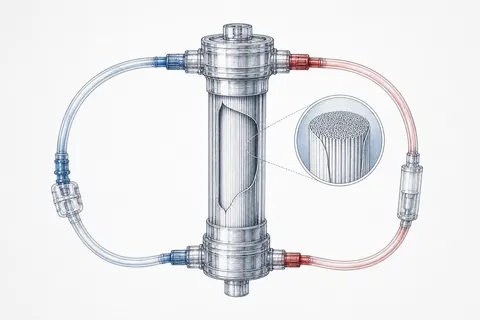
What Is EBO2 (EBOO)? The Procedure, the Evidence, and What Regulators Say
What EBO2 (EBOO) is, step by step from the papers that introduced it, how the US clinic version differs, what regulators say, and what is still unknown.
What Does the EBO2 (EBOO) Filter Actually Remove?
What the EBO2 (EBOO) filter removes: what papers measured, what is theory borrowed from dialysis, what clinics claim, and what a filtrate lab report must show.