What Does the EBO2 (EBOO) Filter Actually Remove?
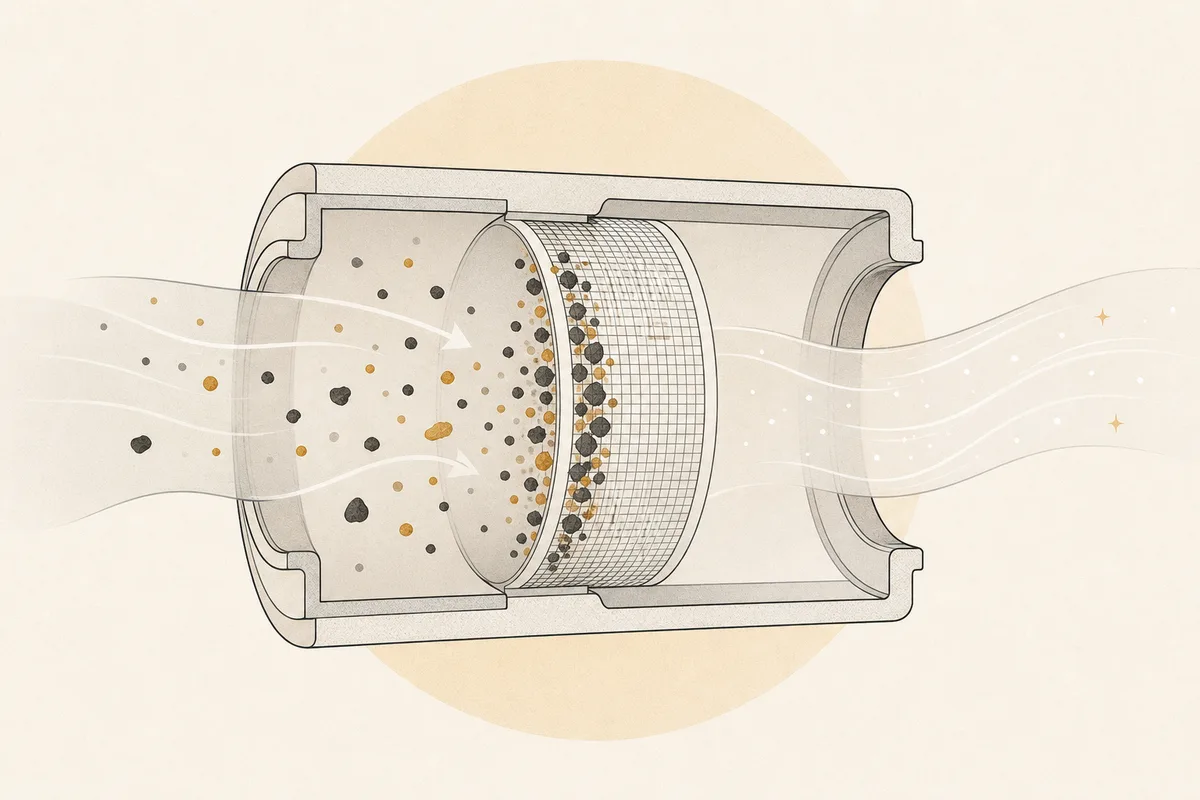
No published study we found has measured what an EBO2 (also called EBOO) circuit removes from a patient’s blood. The papers we hold measured other things: how much ozone blood takes up [11], oxidation markers in blood after a session [10], how well a device moves gas into saline [8], how much ozone passes through dialysis filters [9], and toxins in one patient’s urine [12]. Claims that the filter removes heavy metals, microplastics, cholesterol, or pathogens therefore rest either on theory borrowed from kidney dialysis or on what clinics say. This guide separates the three, using federal dialysis regulations, the EBOO papers’ own descriptions of the circuit, and the clinics’ words, and ends with the checks a lab report on filtrate would have to pass. Ozone therapy is not FDA-approved for any condition, and federal regulation describes ozone as “a toxic gas with no known useful medical application in specific, adjunctive, or preventive therapy” [18].
How a dialysis membrane moves material out of blood
Clinics compare EBOO with dialysis [14][16], so the dialysis rules are the place to start. In a hemodialysis system, blood flows through one compartment of the dialyzer and “undesirable substances in the blood pass through the semipermeable membrane into the dialysate” in the other [2]. The regulation for high permeability systems names two ways this happens: “convection (via a high ultrafiltration rate)” and “diffusion (via a concentration gradient in dialysate),” with the machine controlling “the rate at which fluid is removed from the patient” [1]. In the words of the National Institute of Diabetes and Digestive and Kidney Diseases, blood passes through “very thin, hollow fibers” while dialysis solution flows the other way outside them, and “waste products from your blood move into the dialysis solution” [4].
What can cross depends on the membrane. A high permeability dialyzer is defined by an ultrafiltration coefficient “greater than 8 milliliters per hour per conventional millimeter of mercury” [1]. A 2026 nephrology review describes newer medium cut-off membranes with “mean pore sizes substantially larger” than standard high-flux membranes, which clear larger molecules at a cost: there is “ongoing debate about the appropriate balance between large solute clearance and albumin loss” [5]. Since 2024, FDA’s rule for dialyzers with an “expanded solute removal profile” defines the “middle” molecular weight range as 0.5 kDa to 60 kDa and requires each such device to be tested for “clearance rates,” “sieving coefficients,” and other measures [3].
Two points follow from the rules themselves. Removal in dialysis is measured, solute by solute, under stated conditions [3]. And removal needs a destination: the dialysate, or the fluid pulled across by ultrafiltration [1][2].
What sits in an EBO2 circuit
Two kinds of cartridge appear in the sources. The Siena group that developed EBOO tried dialysis membranes first and found them “unsuitable because they are hydrophilic and vulnerable to O3” [6]. By 2001 it had concluded that semipermeable membranes, except for one, “were gas-transfer inefficient, allowed ultrafiltration and were more or less vulnerable to O3” [7]. Its 2007 device used microporous, ozone-resistant polypropylene fibers with a membrane area of 0.22 m², blood on the outside and an oxygen-ozone gas mixture flowing inside [8]. When the group later tested four dialysis filters with ozone, it found fibers “somewhat altered by ozone” and warned that the filters “may release toxic compounds harmful for the patients” [9].
Several US sources describe dialyzers instead. A 2023 US paper circulated blood through “a Renak CTA (cellulose triacetate) 1500 dialysis chamber,” with ozone gas running inside the fibers and blood around them [11]. An FDA warning letter records “ABLE® H-200 High Flux Polyethersulfone Disposable Haemodialysers” sold in one maker’s EBOO kits [13]. One clinic that offers the procedure says EBOO “uses the same dialyzer filters, but in a very different arrangement” and “does not use dialysate fluid” [14]. Our EBOO vs dialysis guide sets the two procedures side by side.
With no dialysis solution in the circuit, the sources point to three places material from the blood can go. Fluid can cross the membrane: the developers counted ultrafiltration against dialysis membranes [7], and the 2023 paper describes a 2 L canister “used to collect dialysis chamber drainage” [11], which clinics call a “collection container” or “catch canister” [14] and a “collection cup” [15]. Gases can cross it: in tests of a sepsis prototype, one pass raised oxygen and lowered carbon dioxide in blood [19]. And blood components can stay on it: the developers’ exchanger clogged progressively with cells [6]. None of these sources reports the volume of the drainage or its laboratory contents.
Measured, theorized, and said by clinics
Every figure here is in the units its source uses. “Measured” means a paper reports a measurement; it does not mean the measurement shows removal.
| Statement | Status | What the source reports |
|---|---|---|
| Blood takes up ozone in the circuit | Measured, 12 patients, one clinic | Average uptake of 37% of the generator’s output, range 25 to 50%; about 460,000 μg in one hour at 30 μg/mL, by the authors’ calculation [11] |
| The equipment itself consumes ozone | Measured, no blood | An average loss of 23% through a dry dialyzer and tubing [11] |
| Ozone changes the blood | Reported in the developers’ review | Thiobarbituric acid reactants up four- to fivefold and plasma protein thiols down after a session, “without any appreciable erythrocyte haemolysis” [10] |
| Dialysis filters can serve as gas exchangers | Measured, bench | Gas-exchange yield “from 0 up to 70%”; fibers “somewhat altered by ozone” [9] |
| Toxins leave the body after EBOO | Measured in urine, one patient | Average declines of 64.8% for mycotoxins, 25.7% for heavy metals, and 55.1% for environmental toxins in urine ratios (µg/g creatinine); nickel rose overall [12] |
| Ozonated blood carries fewer live bacteria | Measured, different prototype, pigs and blood samples | One pass cut live E. coli by 27% [19] and live P. aeruginosa by 53% [20]; in pigs, bacteria in the bloodstream did not differ from untreated animals [19][20] |
| Middle molecules cross the membrane and collect in the canister | Theory | One clinic lists beta 2 microglobulin, “urea/uric acid, cytokines, adipokines and vitamin B12, and homocysteine,” and says this “is elucidated from dialysis therapy and cannot be directly applied to EBOO therapy” [14] |
| Heavy metals cross the membrane | Theory | The same clinic: metals “freely circulating in your bloodstream could also theoretically pass through the tubules” [14] |
| The filtrate holds heavy metals, microplastics, and parasites | Clinic statement | Another clinic: “there are claims” to this effect, and “current research is still investigating the exact composition” [15] |
| The circuit removes microplastics | Clinic test of water | Distilled water run through a circuit with a Renak CTA-1500 dialyzer: microplastics at 0.006 Count/mL (1 to 5 µm) and 0.002 Count/mL (10 to 50 µm) in the control sample, none detected after the circuit [16] |
The urine row needs a caution of its own. The 2025 case measured what the patient excreted at three points over 131 days, not what the circuit took out, with no control for exposure in between [12]. The bacteria row comes from a different device, a prototype that cools blood and mixes it with oxygen-ozone gas, run for 30 minutes in one study and within a 4-hour experiment in the other, in pigs with sepsis [19][20]. And the water test sampled one liter of distilled water from plastic containers before and after the circuit [16]. It does not show what happens to particles in blood, or to particles in the body.
As of October 4, 2026, 151 of the 174 clinics whose EBO2 page we could read claim a detoxification benefit. The “From our data” section below breaks those claims down and shows how many clinics name the device they use.
What the canister holds, and why its look proves little
Clinics and patients often point to what collects during a session. One clinic captions a photo of its canister “Clear fluid collection and foam” [14]. Another says “the contents and appearance of the filtered materials can vary significantly between patients and even between different sessions for the same patient” [15]. A patient testimonial on a third clinic’s page describes “less than 100 mL of inflammatory product dialyzed out” at one session and “almost 500 mL” at another [16].
None of these is an analysis. A volume of fluid says nothing about what is dissolved in it, and the sources give other explanations for what a cartridge can hold. The developers reported that their exchanger “became less effective (low pO2 values) due to progressive clogging with cells” in sheep [6], and that uncoated polypropylene fibers led to “platelet aggregation and blood coagulation,” problems that “become prohibitive in the presence of ozone” [7]. That does not tell anyone what a given clinic’s residue is. It shows that color, foam, or volume cannot settle the question without a laboratory.
What a filtrate lab report would have to show
A clinic that says it has tested its filtrate can be asked for the report. These checks come from how dialysis removal is tested [3] and from the gaps in the sources above.
- The sample. Patient blood, canister fluid, or water? The one published clinic test used distilled water [16].
- The laboratory and the method. Who ran the test, with what method, and whether the lab is accredited for it.
- The amount, in units. A concentration, such as micrograms per liter, and the volume collected in milliliters, so the total removed can be worked out.
- A control. The same circuit run with saline or without ozone, and the patient’s blood before the session. Without one, a substance in the canister could have come from the tubing, the cartridge, or the water.
- Blood levels before and after. Removal from blood should show in blood, measured at the same points in time.
- Scale. The amount removed set against the amount in the blood and in the body, so the result can be judged.
- Repeat runs and other patients. One sample is an anecdote, and dialyzer testing is done under stated conditions of use [3].
- The membrane itself. Whether the cartridge was tested for what it releases under ozone, the concern the developers raised about dialysis filters [9].
Procedures that publish what they remove
Some extracorporeal procedures are built to remove one thing and report it. An American Heart Association statement calls lipoprotein apheresis “a valuable but underused adjunctive therapeutic option for low-density lipoprotein cholesterol and lipoprotein(a) lowering,” with effects measured in blood lipids [17]. In therapeutic plasma exchange, a patient fact sheet published by the American Society for Apheresis describes a machine that “separates and removes the patient’s plasma, replacing it with another fluid,” most commonly “5% human albumin” [21]; our plasmapheresis comparison covers it. Both procedures are defined by what they take out of the blood. No EBOO source we found says what EBOO takes out. Our clinic directory records what each clinic states about its own service, including the device where it names one.
What we could not verify
- What any EBOO canister or cartridge contains. We found no published laboratory analysis, and the one clinic test we found used water [16].
- How much fluid an EBOO circuit loses across the membrane in a session. The 2023 paper mentions the canister but no volume [11], and the only figures we found are in a patient testimonial [16].
- Whether drainage is discarded or returned to the patient in each clinic’s setup.
- The laboratory, method, and replicate results behind the clinic’s water test, which its page calls “a rough draft” [16].
- The full texts of the Siena development papers, which we could read only as abstracts [6][7][9].
- Whether the dialyzers used for EBOO in the US have been tested for what they release under ozone, the concern raised in 2010 [9].
How this guide was made
This guide rests on 21 sources: four federal regulations and an FDA warning letter, an NIH page, a patient fact sheet published by the American Society for Apheresis, 11 papers listed on PubMed, and three clinic pages, which are cited only for what those clinics state. The claim figure comes from our dataset of clinic pages, as of October 4, 2026. Drafting used AI tools. A human editor has not yet checked this guide claim by claim against its sources. No clinical reviewer has signed off on this guide yet.
From our data
What clinics tell you before you book
Of 174 clinics whose EBO2 page we could read, this many:
The full report. Read between September 28, 2026 and October 4, 2026.
What clinics' EBO2 pages say it does
Of 174 clinics whose EBO2 page we could read, 163 state a health benefit. By kind of benefit:
A statement on a clinic's page is a claim, not evidence. See what the research shows.
Frequently asked questions
Does EBO2 remove heavy metals?
No study we found has measured metals in an EBO2 circuit or its drainage. One 2025 case report measured one patient's urine: heavy-metal ratios fell 25.7% on average across two series of treatments, but nickel rose overall. One clinic says freely circulating metals could theoretically cross the membrane and that no validated US research shows what the canister holds.
What is in the canister or collection cup after a session?
No published study we found has analyzed it. One clinic captions a photo of its canister as clear fluid and foam, another says the contents vary between patients and between sessions, and a testimonial on a third clinic's page describes less than 100 mL at one session and almost 500 mL at another.
Does EBO2 remove microplastics?
No study of blood that we found has tested it. One clinic published a test in which distilled water, not blood, was run through its circuit: microplastics were detected in the control water and not in the water after the circuit. A single water sample cannot show what happens to blood or to particles inside the body.
Is the EBO2 filter the same as a dialysis filter?
Sometimes. The Italian developers used a purpose-built polypropylene gas exchanger, while a 2023 US paper used a cellulose triacetate dialysis chamber and an FDA warning letter records hemodialyzers sold in EBOO kits. Either way, EBOO puts gas, not dialysis solution, on the other side of the membrane.
Does EBO2 remove cholesterol?
No EBOO study we found has measured cholesterol removal. Lipoprotein apheresis, a different procedure built to lower LDL cholesterol and lipoprotein(a), is described by the American Heart Association as a valuable but underused option for lowering LDL cholesterol and lipoprotein(a).
Sources
- 21 CFR 876.5860 High permeability hemodialysis system. eCFR (FDA), 2026. Regulatory
- 21 CFR 876.5820 Hemodialysis system and accessories. eCFR (FDA), 2026. Regulatory
- 21 CFR 876.5862 Hemodialyzer with expanded solute removal profile. eCFR (FDA), 2026. Regulatory
- Hemodialysis. National Institute of Diabetes and Digestive and Kidney Diseases (NIH), 2018. Other
- Dialysis membranes and hemodialyzers. Contributions to Nephrology (PubMed), 2026. Peer-reviewed Our notes on this study: Dialysis membranes and hemodialyzers
- Ozonation of blood during extracorporeal circulation. I. Rationale, methodology and preliminary studies. International Journal of Artificial Organs (PubMed), 1999. Peer-reviewed Our notes on this study: Ozonation of blood during extracorporeal circulation. I. Rationale, methodology and preliminary studies
- Ozonation of blood during extracorporeal circulation. II. Comparative analysis of several oxygenator-ozonators and selection of one type. International Journal of Artificial Organs (PubMed), 2001. Peer-reviewed Our notes on this study: Ozonation of blood during extracorporeal circulation. II. Comparative analysis of several oxygenator-ozonators and selection of one type
- Oxygenation-ozonation of blood during extracorporeal circulation: in vitro efficiency of a new gas exchange device. Artificial Organs (PubMed), 2007. Peer-reviewed Our notes on this study: Oxygenation-ozonation of blood during extracorporeal circulation: in vitro efficiency of a new gas exchange device
- Are dialysis devices usable as ozone gas exchangers?. Artificial Organs (PubMed), 2010. Peer-reviewed Our notes on this study: Are dialysis devices usable as ozone gas exchangers?
- Extracorporeal blood oxygenation and ozonation: clinical and biological implications of ozone therapy. Redox Report (PubMed), 2005. Peer-reviewed Our notes on this study: Extracorporeal blood oxygenation and ozonation: clinical and biological implications of ozone therapy
- Ozone dialysis delivers three or more times the ozone than other forms of ozone blood treatment. Medical Gas Research (PubMed), 2023. Peer-reviewed Our notes on this study: Ozone dialysis delivers three or more times the ozone than other forms of ozone blood treatment
- Observed Reduction in Urinary Toxin Excretion With Extracorporeal Blood Oxygenation and Ozonation (EBOO) Treatment in an 88-Year-Old With Chronic Anemia: A Case Report. Cureus (PubMed), 2025. Peer-reviewed Our notes on this study: Observed Reduction in Urinary Toxin Excretion With Extracorporeal Blood Oxygenation and Ozonation (EBOO) Treatment in an 88-Year-Old With Chronic Anemia: A Case Report
- Warning Letter: O3UV, LLC - 668840 - 07/07/2025. US Food and Drug Administration (CBER), 2025. Regulatory
- EBOO/EBO2 Ozone Therapy. San Diego Center for Restorative Medicine, 2026. Clinic-stated
- EBOO Ozone Therapy. The James Clinic, 2026. Clinic-stated
- EBOO Ozone Dialysis. USA Medical Research Institute, 2026. Clinic-stated
- Lipoprotein apheresis: utility, outcomes, and implementation in clinical practice: a scientific statement from the American Heart Association. Arteriosclerosis, Thrombosis, and Vascular Biology (PubMed), 2024. Peer-reviewed Our notes on this study: Lipoprotein apheresis: utility, outcomes, and implementation in clinical practice: a scientific statement from the American Heart Association
- 21 CFR 801.415 Maximum acceptable level of ozone. eCFR (FDA), 2026. Regulatory
- Evaluation of an extracorporeal ozone-based bactericide system for the treatment of Escherichia coli sepsis. Intensive Care Medicine Experimental (PubMed), 2022. Peer-reviewed Our notes on this study: Evaluation of an extracorporeal ozone-based bactericide system for the treatment of Escherichia coli sepsis
- Immunomodulation by extracorporeal ozone-based bactericide system in porcine Pseudomonas aeruginosa septic shock. Scientific Reports (PubMed), 2025. Peer-reviewed Our notes on this study: Immunomodulation by extracorporeal ozone-based bactericide system in porcine Pseudomonas aeruginosa septic shock
- Procedure: Therapeutic Plasma Exchange (also referred to as therapeutic plasmapheresis). American Society for Apheresis, 2021. Other