EBO2 (EBOO) vs 10-Pass Ozone: A Side-by-Side From the Primary Sources
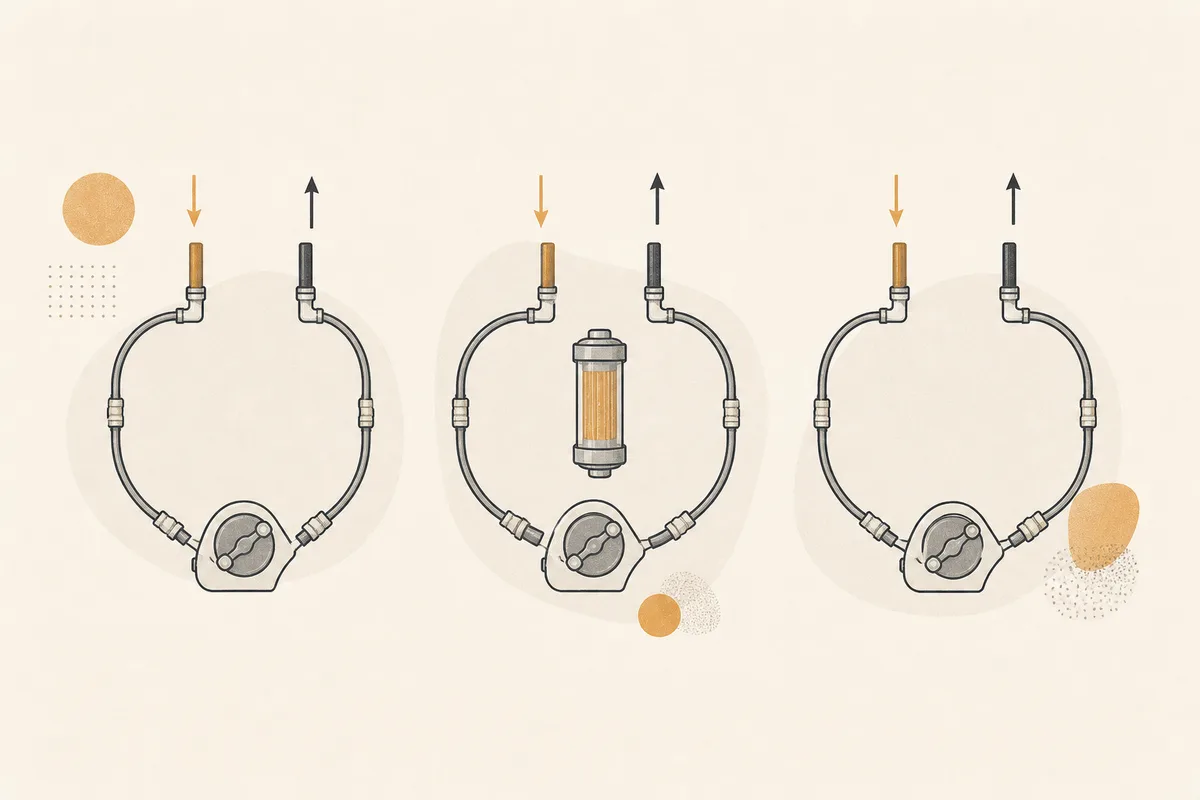
EBO2 (also called EBOO) and 10-pass ozone are the two methods US clinics market as the highest-dose ways of ozonating blood. In 10-pass, 200 mL of blood is drawn into a vacuum flask, mixed with ozone gas under pressure and returned, ten times in about an hour [1]. In EBOO, blood is pumped continuously from one arm, through a gas exchanger or dialysis filter where it meets the gas, and back into the other arm, for about an hour [2][3]. Ozone therapy is not FDA-approved for any condition [4].
This page sets the two side by side from the papers that describe them, then takes apart the dose comparison that several clinic pages quote, which says EBOO delivers “three or more times” the ozone of 10-pass [2]. The short version: the two move similar amounts of blood, the dose comparison mixes calculated and theoretical figures, and no study has compared what either does for patients.
The two procedures side by side
Figures are as each source states them; where we combined them, we say so.
| Row | 10-pass (ozone high-dose therapy) | EBOO, US practice | EBOO, Siena papers |
|---|---|---|---|
| Source | Six-patient study from the pioneer’s practice in Austria [1] | 12-patient measurement study from a California clinic [2] | Developers’ review and trial [5][6] |
| How blood meets ozone | 200 mL drawn into a vacuum flask; 200 mL of gas pumped in under pressure; blood returned under positive pressure | Pumped continuously past hollow fibers, with gas flowing the opposite way, in a dialysis chamber | Continuous circuit through a purpose-built gas exchanger [7] |
| Ozone concentration | 70 µg/mL | 10 to 60 µg/mL, mostly 30 to 40 | 0.5 to 1 µg/mL |
| Blood per session | 2,000 mL in ten batches of 200 mL (our arithmetic) | 30 to 40 mL a minute for one hour, so 1.8 to 2.4 liters (our arithmetic) | Up to 4,800 mL in one hour |
| Time | About one hour for ten passes | Exactly one hour | One hour |
| Anticoagulant | 7,500 units of heparin in the flask | Heparin drip, 15,000 units in a liter of saline, about 300 mL reaching the patient | Heparinized blood |
| Pressure | Up to 2 atmospheres in the flask, by the California paper’s description [2] | None described | None described |
| Filter | None | Dialysis chamber (cellulose triacetate) | Gas exchanger, not a dialysis filter [8] |
| Device named | Hyper Medozon comfort (Herrmann Apparatebau, Germany) | Zotzmann Ozone 2000 generator; Renak CTA 1500 chamber | L001 gas exchanger (2007) |
| Sessions in the study | Two, within one week | Not stated; routine repeated sessions | 14 over 7 weeks as the standard cycle |
Two things stand out. First, the blood volumes are close. Ten passes of 200 mL come to 2 liters, and the California EBOO pump speeds move 1.8 to 2.4 liters in an hour; only the Siena description, at about 80 mL a minute, reaches 4.8 liters [1][2][5]. Second, the ozone concentrations run the other way from what volume pitches imply: 10-pass uses the highest concentration of the three, and the Siena version of EBOO the lowest.
Each liter of blood also meets ozone differently. In 10-pass, a batch of blood is mixed with an equal volume of gas in a bottle and shaken [1]. In EBOO, flowing blood takes up ozone across a membrane, and the California group found that how much it took up rose with pump speed, by up to 30 percent at 40 mL a minute compared with 30 [2]. Why US EBOO uses a dialysis filter, and how that compares with hemodialysis, is in EBO2 vs dialysis; the heparin in both methods is covered in blood thinners and other medicines.
The dose comparison: what was measured and what was assumed
The “three or more times” figure comes from the title and conclusion of the 2023 California paper [2]. The paper is careful about its own method, but the comparison it draws mixes figures of different kinds.
| Figure | Method | How the paper gets it | Kind of figure |
|---|---|---|---|
| 37 percent average uptake (range 25 to 50) | EBOO, 85 measurements in 12 patients | Ozone concentration measured at the generator and in the exhaust gas, corrected for a 23 percent loss measured in an empty, dry dialyzer | Calculated from gas measurements; uptake by blood is inferred, not measured in blood |
| About 460,000 µg | EBOO at 30 µg/mL for one hour | (30 µg/mL minus 7 lost in the equipment) × 0.9 L of gas a minute × 60 minutes × 37 percent | Calculated |
| About 558,900 µg | EBOO at a higher blood flow | The same sum at a 45 percent uptake | Calculated |
| Up to 140,000 µg | 10-pass | Ten passes of 200 mL of gas at 70 µg/mL | Theoretical maximum: all the ozone put in, counted as delivered |
| 14,000 µg | One hyperbaric pass | 200 mL × 70 µg/mL | Theoretical maximum |
| 10,000 µg (6,000 to 14,000) | Gravity MAH | 200 mL of gas at 50 (30 to 70) µg/mL, which the paper notes the plastic bag may absorb | Theoretical maximum |
| 3.28 times | EBOO against 10-pass | 460,000 ÷ 140,000 | A calculated figure divided by a theoretical one |
The paper’s own wording marks the difference: for the other methods it gives the “maximum theoretical delivery of ozone”, and for 10-pass “a total of up to 140,000 μg” [2]. The 10-pass paper uses the same arithmetic and says each pass “delivers 14,000 μg” [1]; neither paper measured how much ozone 10-pass blood actually took up.
So the EBOO figure counts only the ozone that did not come back out in the exhaust, while the 10-pass figure counts all the ozone put into the flask. The two numbers answer different questions, and the ratio between them is not a measured difference. The California authors also note limits of their own: they did not check whether unabsorbed ozone was destroyed after leaving the chamber, they do not know whether other dialysis chambers lose ozone the same way, and they did not study clinical benefits or risks [2]. Whether more ozone is better is a separate question the paper does not address, and its authors note that “little is reported on the efficacy of higher doses of ozone vs. lower dose” [2].
The one 10-pass study
The only peer-reviewed study of 10-pass in our library is König and Lahodny’s 2022 pilot [1]. Its parameters, as the full text gives them:
- Patients. Six consecutive patients aged 55 to 74 who came to Dr. Lahodny’s private practice in St. Pölten, Austria, for preventive treatment; four had no current disease, and none took medication.
- Treatment. Two sessions of ten passes within one week, on a Hyper Medozon comfort device. Each pass drew 200 mL of blood into a vacuum flask holding 7,500 units of heparin, added 200 mL of gas at 70 µg/mL under pressure, and returned the blood using positive pressure of 0.9 atmosphere. Ten passes took about an hour. The paper does not say whether the heparin is added once or with every pass.
- What was measured. A bioenergetic health index, a laboratory measure of energy use in white blood cells, before treatment, after the first session and after the second.
- What it found. The index rose by the second session, driven by maximum respiration and reserve capacity. Against the starting value, the change was statistically significant after the second session (p = 0.045) but not after the first (p = 0.198).
- Limits. Six patients, no comparison group, one week of follow-up, and a laboratory marker rather than any symptom or illness. The authors write that more patients should be included in further studies.
- Interests. Lahodny “has pioneered the 10-pass OHT method” and uses it at his private clinic; the paper says he does not hold a patent on it.
The paper also dates the method’s use at that practice to 2015 [1]. The California paper reports a survey of 10-pass therapists, presented at a professional meeting, that found no significant toxicity in more than 4,000 treatments apart from rust-colored urine in a small minority of patients; we have not read that survey [2].
The EBOO studies, briefly
EBOO has more papers, but not better ones for this question. As of October 2, 2026, our library lists six studies of EBOO as given to people, the California paper among them, shown with their procedures in the table under “From our data”. The only randomized trial compared EBOO with intravenous prostacyclin in 28 patients with peripheral artery disease and found greater regression of skin lesions with EBOO, with no change in leg circulation in either group [6]. The California paper measured gas and reports no outcomes [2]. Its authors write that patients who had received both methods showed a “near universal preference” for EBOO, an observation, not a measured result [2]. For the batch method that both grew from, a controlled crossover study in 12 hemodialysis patients found that nine sessions of ozonated autohemotherapy, 250 mL of blood at 50 µg/mL, did not change two inflammation markers compared with nine oxygen-only sessions [9]. More on all of these is in does EBO2 work? and what EBO2 is.
What clinic pages say about the two
As of October 4, 2026, we could read the EBO2 pages of 174 of the 177 clinics in our directory. Of those 174:
- Thirty-six mention 10-pass ozone.
- Eleven repeat the three-times comparison or the figures behind it. None says that the 10-pass and MAH figures are theoretical maximums.
- Five carry nearly the same sentence, saying traditional or 10-pass ozone “treats only a small portion” of the blood while EBO2 “treats the majority”, at 4 to 6 or 5 to 7 liters.
A few pages come closer to the papers. One sets out 10-pass as 200 mL “drawn, ozonated, and returned 10 times” and puts its blood volume at 1.5 to 2 liters [10]. Another clinic that offers EBOO says ozone dosing is “measured as mcg/ml, not volume of blood treated or filtered” [11].
Prices for the two are not comparable from our data, which records EBO2 prices only; see the price report and the cost guide.
What a fair comparison would need
We found none of these in the published record:
- The same measurement for both: ozone taken up by blood, measured the same way in 10-pass and in EBOO, instead of a calculation for one and a maximum for the other.
- A head-to-head trial in people with a defined condition, with a comparison group that gets neither, and outcomes that matter to patients.
- Safety recorded the same way for both, with adverse events counted by people other than the practitioners.
- Both versions of EBOO, the Siena gas exchanger and the US dialysis filter, since their settings differ many times over.
What we could not verify
- The survey of 10-pass therapists that the California paper cites. It was presented at a meeting, and we have not found it published.
- When 10-pass began. The 2022 paper dates its use at the pioneer’s practice to 2015; other accounts of the method’s origin are not peer-reviewed.
- Whether the heparin in the 10-pass flask is given once or with each pass.
- How much ozone 10-pass blood actually takes up. No paper we found measured it.
- Whether the dialysis chambers used in US EBOO behave like the one in the California paper.
- Anything about 10-pass prices or session counts from our data, which covers EBO2 only.
How this guide was made
This guide draws on 11 sources: the 2022 10-pass paper and the 2023 California paper read in full on PubMed Central, Siena papers read as abstracts and one in full, a federal regulation, and clinic pages saved by our research pass. Where we combined published figures, such as liters of blood per session, we say “our arithmetic”. The clinic counts come from our dataset of 177 clinics, read between September 28, 2026 and October 4, 2026, and were counted from the saved pages. Drafting used AI tools. A human editor has not yet checked this guide claim by claim against its sources, and no clinical reviewer has signed off yet.
From our data
The procedure as the EBOO studies report it
| Study | Participants | Sessions | Session length | Blood treated |
|---|---|---|---|---|
| Observed Reduction in Urinary Toxin Excretion With Extracorporeal B..., 2025 | 1 person | Two distinct series of three sequential EBOO treatments; urinary toxin/creatinine ratios monitored at baseline, after series I and after series II | Not reported | Around 2 liters of blood processed in one treatment (clinic protocol) |
| Ozone dialysis delivers three or more times the ozone than other fo..., 2023 | 12 people | Not reported | exactly 1 hour | Not reported |
| Extracorporeal blood oxygenation and ozonation: clinical and biolog..., 2005 | Not reported | 14 sessions over 7 weeks (the standard therapeutic cycle) | 1 h per session | Up to 4800 ml of heparinized blood in 1 h of extracorporeal circulation |
| Extracorporeal blood oxygenation and ozonation (EBOO): a controlled..., 2005 | 28 people | 210 EBOO treatments (per-patient schedule not stated in the abstract) | Not reported | Not reported |
| Necrotizing fasciitis successfully treated with extracorporeal bloo..., 2002 | 1 person | Not reported | Not reported | Not reported |
| Extracorporeal blood oxygenation and ozonation (EBOO) in man. preli..., 2000 | Not reported | six treatments (volunteer author); not stated for the patients | Not reported | Not reported |
Figures are as the papers state them, with their own units. All studies side by side.
Frequently asked questions
Is EBO2 better than 10-pass ozone?
No study has compared them on any health outcome, so neither can be called better. The comparison clinics quote is about ozone dose, and it sets a calculated figure for EBOO against a theoretical maximum for 10-pass, so it is not like for like.
How much ozone does 10-pass deliver?
The only 10-pass paper says each pass delivers 14,000 micrograms and ten passes 140,000. That is the amount of ozone put into the flask, 200 mL of gas at 70 micrograms per milliliter each time, not an amount measured in blood.
Does EBO2 treat more blood than 10-pass?
Not by much, going by the published parameters. Ten passes of 200 mL move 2 liters of blood in batches; the 2023 California EBOO paper's pump speeds move 1.8 to 2.4 liters in an hour. The original Siena papers describe up to 4,800 mL an hour. Clinic pages that say 10-pass treats only a small portion of the blood do not match these figures.
Is 10-pass the same as hyperbaric oxygen therapy?
No. In 10-pass the pressure is inside the glass flask holding 200 mL of blood and gas, up to 2 atmospheres by one paper's description. Hyperbaric oxygen therapy puts the whole person in a pressurized chamber. The 'hyperbaric' in hyperbaric ozone refers only to the flask.
Does 10-pass use a filter?
No. Blood is mixed with ozone in the flask and returned. EBOO passes blood through a gas exchanger or, in US practice, a dialysis filter, which is where the filtering that clinic pages describe comes in.
Sources
- Ozone high dose therapy (OHT) improves mitochondrial bioenergetics in peripheral blood mononuclear cells. Translational Medicine Communications (PubMed Central), 2022. Peer-reviewed
- Ozone dialysis delivers three or more times the ozone than other forms of ozone blood treatment. Medical Gas Research (PubMed Central), 2023. Peer-reviewed
- Oxygen/ozone as a medical gas mixture. A critical evaluation of the various methods clarifies positive and negative aspects. Medical Gas Research (PubMed Central), 2011. Peer-reviewed
- 21 CFR 801.415 Maximum acceptable level of ozone. eCFR (FDA), 2026. Regulatory
- Extracorporeal blood oxygenation and ozonation: clinical and biological implications of ozone therapy. Redox Report (PubMed), 2005. Peer-reviewed Our notes on this study: Extracorporeal blood oxygenation and ozonation: clinical and biological implications of ozone therapy
- Extracorporeal blood oxygenation and ozonation (EBOO): a controlled trial in patients with peripheral artery disease. International Journal of Artificial Organs (PubMed), 2005. Peer-reviewed Our notes on this study: Extracorporeal blood oxygenation and ozonation (EBOO): a controlled trial in patients with peripheral artery disease
- Oxygenation-ozonation of blood during extracorporeal circulation: in vitro efficiency of a new gas exchange device. Artificial Organs (PubMed), 2007. Peer-reviewed Our notes on this study: Oxygenation-ozonation of blood during extracorporeal circulation: in vitro efficiency of a new gas exchange device
- Ozonation of blood during extracorporeal circulation. I. Rationale, methodology and preliminary studies. International Journal of Artificial Organs (PubMed), 1999. Peer-reviewed Our notes on this study: Ozonation of blood during extracorporeal circulation. I. Rationale, methodology and preliminary studies
- No effects of ozonated autohemotherapy on inflammation response in hemodialyzed patients. Mediators of Inflammation (PubMed), 2004. Peer-reviewed Our notes on this study: No effects of ozonated autohemotherapy on inflammation response in hemodialyzed patients
- EBOO Therapy. NOVA IV Therapy, 2026. Clinic-stated
- EBOO/EBO2 Ozone Therapy. San Diego Center for Restorative Medicine, 2026. Clinic-stated