At-Home Ozone Therapy vs EBO2 (EBOO): What Regulators Say About Home Ozone Devices
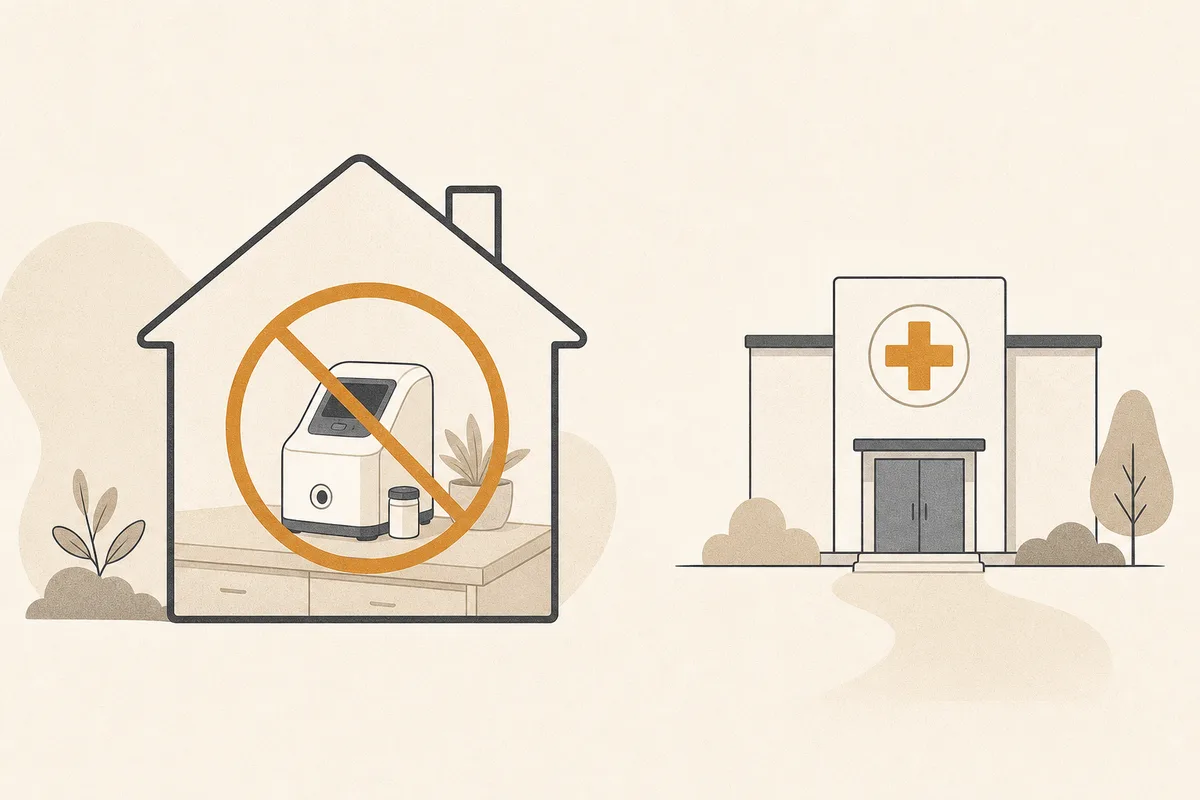
EBO2 (also called EBOO) is a clinic procedure: blood is pumped from one arm through a device where it meets ozone gas and back into the other arm, with an anticoagulant in the line, for about an hour [1][2]. Nothing sold for home use does that. What people buy for home use are ozone generators for room air, cleaners for CPAP machines, ozone saunas and tents, and kits for putting ozone gas into a body cavity, and US and Canadian regulators have each spoken about some of them [3][4][5][6]. Ozone therapy is not FDA-approved for any condition [7].
This guide compiles what those regulators say, with their exact figures; lists the injuries in our regulatory database by the route that caused them; and sets out why a blood circuit is a different kind of exposure from anything a home device produces. The four newest records in our database are shown under “From our data”.
What US rules say about ozone devices
The FDA’s device labeling rule, dating from 1976, describes ozone as “a toxic gas with no known useful medical application in specific, adjunctive, or preventive therapy” [7]. Its main points for home devices:
- The 0.05 ppm ceiling. A device that generates ozone, by design or as a byproduct, is adulterated or misbranded if it puts more than 0.05 parts per million into the air circulating through it, or lets ozone build up above 0.05 ppm in enclosed spaces people occupy for long periods, such as houses, apartments, hospitals and offices [7].
- The label. A device that releases ozone must state the maximum concentration it may produce and the smallest room it can be used in without exceeding the limit [7].
- Medical use. Any ozone-generating device used or meant for use “in any medical condition for which there is no proof of safety and effectiveness” is adulterated or misbranded [7].
- The warning signs. The rule says inhaled ozone irritates the lungs enough to cause pulmonary edema, that its onset “is usually delayed for some hours”, and that because the sense of smell tires quickly, the odor of ozone is “not a reliable index” of how much is in the air [7].
The FDA treats medical ozone generators as devices that need its authorization. In 2014 a dental practice recalled an ozone generator because it was “not approved or cleared by the FDA for medical use”; 16 units had been distributed [8]. In 2025 the FDA told a Michigan firm that its devices for exposing blood to ozone and ultraviolet light were adulterated and misbranded for lack of premarket approval or clearance [9], and federal prosecutors charged a Virginia physician with offenses that included using three FDA-unapproved medical ozone generators, charges that are allegations [10].
The EPA on ozone generators sold as air cleaners
The EPA’s page on these machines, last updated in February 2026, makes five points that apply to any ozone-producing device in a home [3]:
- No approval. It says no agency of the federal government has approved ozone generators for use in occupied spaces, and that an EPA establishment number on the box “does not imply EPA endorsement”.
- Harm. “Whether in its pure form or mixed with other chemicals, ozone can be harmful to health.” Relatively low amounts can cause chest pain, coughing, shortness of breath and throat irritation.
- Following the instructions is not enough. In an EPA study in a home, some generators run on high with interior doors closed often produced 0.20 to 0.30 ppm; in another study, a generator rated for spaces “up to 3,000 square feet” run on high in a 350-square-foot room reached 0.50 to 0.80 ppm, 5 to 10 times public health limits.
- The settings mislead. On some devices the high setting produced 10 times the level of the medium setting, and the ability to smell ozone “rapidly deteriorates in the presence of ozone”.
- Little benefit at safe levels. At concentrations within public health standards, ozone does little to remove indoor air contaminants, and it does not remove viruses, bacteria or mold from the air effectively.
The page sets those readings against the limits it lists: 0.05 ppm for indoor medical devices under the FDA rule, 0.10 ppm for workers averaged over 8 hours, and 0.08 ppm as an 8-hour outdoor standard [3]. A 1989 review of ozone in outdoor air found that peak levels in areas home to more than half the US population caused measurable, temporary changes in lung function, respiratory symptoms and airway inflammation in healthy people exercising outdoors [11].
CPAP cleaners, saunas and home kits
CPAP cleaners. The FDA’s consumer update, current as of August 26, 2024, says there are no FDA-cleared or approved devices for cleaning, disinfecting or sanitizing CPAP machines, that most parts can be cleaned with mild soap and water, and that it has received reports of “unexpected asthma attacks, headaches, and breathlessness” after ozone cleaners were used. It adds that ozone can leak from the equipment into the home during cleaning and that levels inside the equipment “can be above safe limits even several hours after cleaning is completed” [4].
Ozone saunas. Health Canada’s 2022 advisory describes an individual steam chamber fed by an ozone generator and a compressed-oxygen tank, used for about 30 minutes with the head outside, and advertised for detoxing and for treating infections and cancer, among other uses. It says ozone saunas need a medical device licence, that none has been licensed, and that it has received no submissions with evidence for their treatment claims. The risks it lists are headache, cough, dry throat and nausea, with shortness of breath and pulmonary edema at higher levels; delayed treatment because users may not recognize the symptoms; fire or explosion from the oxygen; burns or frostbite from escaping oxygen; and a condition worsening if the sauna replaces standard treatment [5].
Do-it-yourself setups. In April 2020 the FTC warned a San Diego seller whose marketing said “You can do ozone therapy yourself if you invest in our oxygen concentrator/ 5g machine and a tent”, and told it to stop claiming its machine treated or prevented COVID-19 [6].
Insufflation. Putting ozone gas into the rectum or vagina is among the routes the field’s consensus document recommends to practitioners [12]. Bocci’s group wrote that the rectal dose “remains unpredictable” because of gas loss and bowel contents [2]. We found no regulator’s statement specific to home insufflation kits.
The injuries in the regulatory record, by route
As of September 28, 2026, our database holds 34 primary-source regulatory records. The ones that describe a person harmed, or a risk to people, fall into three routes, and none of them is EBOO.
| Route | Record | What it records |
|---|---|---|
| Breathing ozone from a home device | FDA, CPAP cleaners, 2024 | Reports of asthma attacks, headaches and breathlessness after use [4] |
| Breathing ozone from a home device | Health Canada, ozone saunas, 2022 | A list of potential risks; no case counts [5] |
| Gas injected into a vein, in a clinic | Medical Board of California, 2024 | A patient lost consciousness during intravenous ozone treatment in 2020 and was diagnosed with air embolism and stroke [13] |
| Gas injected into a vein, in a clinic | New York appellate court, 2023 | A medical examiner attributed gas emboli and a patient’s death to an intravenous injection of ozone [14] |
| Infection and blood handling, in a clinic | NSW Health Care Complaints Commission, 2025 | A patient’s serious infection and septic shock, which an expert said the treatment most likely caused, at a clinic where the practitioner tried to sterilize single-use items for reuse and had no infection-control procedures [15] |
A published outbreak report, not a regulatory record, adds a case of the third kind: in 2001, six of 31 patients tested after ozone autohemotherapy or ozone injections at a Rome hospital outpatient department had hepatitis C, and the authors concluded that transmission “may occur during medical procedures with limited bleeding” [16].
The harms recorded for home devices come from breathing ozone. The harms recorded in clinics come from putting gas into a vein or from handling blood without infection control. Case reports from the medical literature, route by route, are compiled in ozone therapy adverse events.
Why a blood circuit is a different exposure
A home device puts ozone into the air or a body cavity. EBOO takes blood out of the body and puts it back, and that is what creates its requirements. Each row below is a control the published descriptions of EBOO depend on.
| What EBOO needs | Why, from the sources | A home device |
|---|---|---|
| Two venous lines and a pump | Blood is collected from one vein and returned to another; Bocci’s group called this complex and invasive [2] | No access to the blood |
| An anticoagulant | The California circuit ran a heparin drip [1]; in Australia, one finding against a clinic was that its practitioner obtained prescription-only heparin “from an unknown source” and was “not authorised to be in possession of, or to administer” it [15] | None |
| Sterile, single-use handling of blood | Tuscany’s health council says ozonated blood must be prepared where there is no risk of microbial contamination [17]; the Rome outbreak and the Penrith order record infections linked to ozone procedures [16][15] | Not applicable |
| No gas reaching the vein | The gas mixture “should never be directly injected” into blood vessels because of the risk of oxygen embolism [2]; Tuscany’s clinical governance body says the same [18] | Not applicable |
| Spent gas destroyed before room air | The California circuit sends exhaust gas through an ozone-destruct unit [1] | Ozone generators release it into the room by design, and cleaners can leak it [3][4] |
| Trained staff | EBOO “must be performed by technicians specialized in extravascular blood circulation” [2] | Used by the buyer |
The comparison runs both ways. A home generator lacks the controls a blood circuit needs, and a blood circuit is built to keep ozone out of the room air, where home generators release it [1][3]. Neither tells you whether ozone in the blood does anything useful; that question is covered in does EBO2 work?, and the risks of the clinic procedure in side effects and safety.
Checks you can run on a home ozone device
These come from the regulators’ own pages.
- Is it authorized? The FDA tells CPAP users to make sure an add-on cleaner is FDA-authorized for that purpose [4]. Health Canada points buyers to its Medical Devices Active Licence Listing [5]. Our guide to EBO2 devices and FDA status shows how to look a device up in the FDA’s databases.
- Does the label state its ozone output? Under the federal rule, a device that releases ozone must give the maximum concentration and the smallest room it can be used in [7].
- Does the seller claim it treats a disease? Advertising that a product treats or prevents disease requires “competent and reliable scientific evidence”, which is what the FTC found missing in 2020 [6].
- Would you notice too much ozone? Both the FDA rule and the EPA say smell is not a reliable guide, and the FDA rule says lung injury can appear hours later [7][3].
To find a clinic that offers the clinic procedure, see our directory; to check what a clinic says about the FDA, see Is EBO2 FDA approved?.
What we could not verify
- Retail pages for home insufflation kits, which an earlier version of this page described. Under our rules for automated access we did not re-read them, so we have left out what they say.
- Injury counts. The FDA and Health Canada describe reports and risks but give no numbers, and we know of no registry of injuries from home ozone devices.
- Whether the EPA’s figures, from studies it cites back to the 1990s, hold for devices sold today.
- Any statement by a US regulator specific to home rectal or vaginal insufflation.
- Whether the outbreak and court records involved equipment like that sold for home use. They concern clinic procedures.
How this guide was made
This guide draws on 18 sources: regulators’ pages, rules, letters, orders and court decisions read on the issuing bodies’ sites, and papers read through PubMed, PubMed Central and Europe PMC. The count of regulatory records comes from our regulatory database as of September 28, 2026. Drafting used AI tools. A human editor has not yet checked this guide claim by claim against its sources, and no clinical reviewer has signed off yet.
From our data
What regulators have said
-
June 16, 2026, Agência Nacional de Vigilância Sanitária (Anvisa), Brazil: Nota Técnica nº 41/2026/SEI/GQUIP/GGTPS/DIRE3/ANVISA
Technical note from Brazil's health regulator listing the uses it recognizes for ozone-emitting medical devices: skin cleansing with ozonated vapour, local dental uses, and, only as an adjunct, bagged ozone-oxygen gas for diabetic foot ulcers and acute infected wounds in adults. It says devices may be sold only for approved indications, warns of severe harm from other routes or doses, and replaces Note 43/2022.
-
May 4, 2026, FDA, Office of the Commissioner: Is It Really 'FDA Approved'?
FDA consumer update on what "FDA approved" means. It says FDA does not approve health care providers, that registering an establishment or listing a device does not denote approval or mean a product may be legally marketed, that most high-risk devices need premarket approval, and that moderate-risk devices such as dialysis equipment are marketed through 510(k) clearance.
-
August 21, 2025, Conselho Federal de Medicina (CFM), Brazil: Resolução CFM n° 2.445, de 21 de agosto de 2025
Resolution of Brazil's Federal Council of Medicine authorizing ozone therapy as an adjuvant medical treatment for four kinds of wound (topical use only), knee osteoarthritis and disc-related low back pain, with facility and specialist rules. It bars use on cancerous wounds outside approved research, requires Anvisa-regularized generators, and revokes Resolution 2.181/2018.
-
July 7, 2025, FDA, Center for Biologics Evaluation and Research: Warning letter to O3UV, LLC (CBER 25-668840)
Warning letter after a 2023 inspection. FDA says the firm's Champion Full Spectrum and EBOO Full Spectrum UV autohemotherapy devices, which expose blood to ozone and UV light for UBI or EBOO, are adulterated and misbranded for lack of premarket approval or clearance. It also cites registration, UDI, and quality-system failures, and notes the EBOO kits included purchased hemodialyzer filters.
Frequently asked questions
Can you do EBO2 at home?
No source we found describes a home version, and the procedure's requirements rule it out: a line in each arm, an anticoagulant such as heparin, a pump, a sterile single-use circuit, an ozone generator with a unit that destroys the spent gas, and staff trained in running blood outside the body. The technique's developers wrote that it must be performed by technicians specialized in extracorporeal circulation.
Are home ozone generators legal?
Selling one is not in itself illegal in the US, but federal rules treat an ozone-generating device as adulterated or misbranded if it releases more than 0.05 ppm into occupied rooms or is used in a medical condition without proof of safety and effectiveness. The EPA says no federal agency has approved ozone generators for use in occupied spaces, and the FTC has warned sellers that marketed home ozone machines to treat disease.
Is an ozone sauna safe to use at home?
Health Canada's 2022 advisory says not to buy or use one. It lists risks including headache, cough, nausea, shortness of breath and fluid in the lungs at higher exposures, delayed treatment because users may not recognize the symptoms, and fire or explosion from the oxygen supply. It also says no ozone sauna has been licensed for sale in Canada.
Do ozone CPAP cleaners work?
The FDA says no device is cleared or approved to clean, disinfect or sanitize CPAP machines, that most parts can be cleaned with mild soap and water, and that ozone can leak into the home and stay above safe limits inside the equipment for hours. It has received reports of asthma attacks, headaches and breathlessness after ozone cleaners were used.
Is rectal ozone insufflation the same as EBO2?
No. Insufflation puts ozone gas into a body cavity, and EBO2 exposes blood to ozone in a circuit outside the body. The two have different risks. One of EBOO's developers wrote that the dose from rectal insufflation is unpredictable, because of gas loss and bowel contents.
Sources
- Ozone dialysis delivers three or more times the ozone than other forms of ozone blood treatment. Medical Gas Research (PubMed Central), 2023. Peer-reviewed
- Oxygen/ozone as a medical gas mixture. A critical evaluation of the various methods clarifies positive and negative aspects. Medical Gas Research (PubMed Central), 2011. Peer-reviewed
- Ozone Generators that are Sold as Air Cleaners. US Environmental Protection Agency, 2026. Regulatory
- Do You Need a Device That Claims to Clean a CPAP Machine?. US Food and Drug Administration, 2024. Regulatory
- Unlicensed ozone saunas may pose serious health risks to users and anyone in close proximity. Health Canada, 2022. Regulatory
- Warning Letter to Forever Ozone: Unsubstantiated Claims for Coronavirus Prevention or Treatment. Federal Trade Commission, Southwest Region, 2020. Regulatory
- 21 CFR 801.415 Maximum acceptable level of ozone. eCFR (FDA), 2026. Regulatory
- Class 2 Device Recall Enaly 1000 BT12 Ozone Generator (Recall Number Z-1576-2014). US Food and Drug Administration, medical device recall database, 2014. Regulatory
- Warning Letter: O3UV, LLC (CBER 25-668840), July 7, 2025. US Food and Drug Administration (CBER), 2025. Regulatory
- U.S. Attorney Erik S. Siebert announces charges as part of DOJ's national health care fraud enforcement action. US Attorney's Office, Eastern District of Virginia, 2025. Regulatory
- Health effects of ozone. A critical review. JAPCA, Journal of the Air Pollution Control Association (PubMed), 1989. Peer-reviewed Our notes on this study: Health effects of ozone. A critical review
- Madrid Declaration on Ozone Therapy, 2nd edition (index of routes). ISCO3 (International Scientific Committee of Ozone Therapy), 2015. Other
- In the Matter of the Accusation Against German Zermeno, M.D., Case No. 800-2022-088393: Decision and Stipulated Settlement. Medical Board of California, 2024. Regulatory
- Matter of Robins v New York City Off. of Chief Med. Examiner, 2023 NY Slip Op 00286. New York Supreme Court, Appellate Division, First Department, 2023. Regulatory
- Ozone Healing Clinic, Penrith: Time-bound Prohibition Order. NSW Health Care Complaints Commission, 2025. Regulatory
- A cluster of hepatitis C virus infections associated with ozone-enriched transfusion of autologous blood in Rome, Italy. Infection Control and Hospital Epidemiology (PubMed), 2005. Peer-reviewed Our notes on this study: A cluster of hepatitis C virus infections associated with ozone-enriched transfusion of autologous blood in Rome, Italy
- Parere 67/2015: Prestazioni di idrocolonterapia, terapia chelante e ozonoterapia. Regione Toscana, Consiglio Sanitario Regionale, 2015. Regulatory
- Allegato alla Decisione CTS n. 20 del 11/12/2018. Regione Toscana, Organismo Toscano per il Governo Clinico, 2018. Regulatory