Health effects of ozone. A critical review
Lippmann M. JAPCA (Journal of the Air Pollution Control Association), 1989.
- Study type
- Review
- People studied
- No participants of its own (review)
- Published
- 1989, JAPCA (Journal of the Air Pollution Control Association)
- Identifiers
- PMID 2659744, DOI 10.1080/08940630.1989.10466554
What the authors reported
A critical review of inhaled ambient ozone air pollution finding that peak levels common in US air cause measurable transient lung-function changes, respiratory symptoms, and airway inflammation, with animal data suggesting cumulative structural lung damage from repeated exposure.
What limits this result
Covers inhaled ambient ozone air pollution, not any medical ozone therapy; describes breathing exposure, not the injected or blood-contact routes clinics use.
Harms reported after ozone therapy, and studies of how ozone exposure affects health. One study rarely settles a medical question; our guides weigh each paper against the rest of the evidence.
How the study was done
- Design
- Critical review of the health effects of ozone
- Read from
- Read from the abstract only; where this page says nothing about an item, the abstract does not report it. Read on September 28, 2026.
Source: Abstract on PubMed
What it measured
- Effects of current peak ambient O3 concentrations in healthy people engaged in outdoor exercise
- Sufficient to elicit measurable transient changes in lung function, respiratory symptoms, and airway inflammation
- Effect of other environmental variables on O3's transient functional changes
- Sometimes greatly potentiated by the presence of other environmental variables
- Repeated O3 exposure at levels within currently occurring ambient peaks, in rats and monkeys
- Cumulative structural damage occurs
- Sensitivity of humans to O3 compared with rats
- Initial evidence from dosimetry models and interspecies comparisons indicates humans are likely to be more sensitive than rats
- Exposure metric that the transient effects of O3 track
- More closely related to cumulative daily exposure than to one hour peak concentrations
- Long-term chronic exposure to O3
- Effects remain poorly defined; recent epidemiologic and animal inhalation studies suggest current ambient levels are sufficient to cause premature aging of the lungs
Source: Abstract on PubMed
Safety as reported
The review concerns inhaled ambient ozone; it reports measurable transient changes in lung function, respiratory symptoms, and airway inflammation in healthy people at current peak ambient O3 concentrations
Source: Abstract on PubMed
Funding and conflicts
Europe PMC's Funding section lists one funder for this work: NIEHS NIH HHS
Source: Abstract on Europe PMC
Where we cite this study
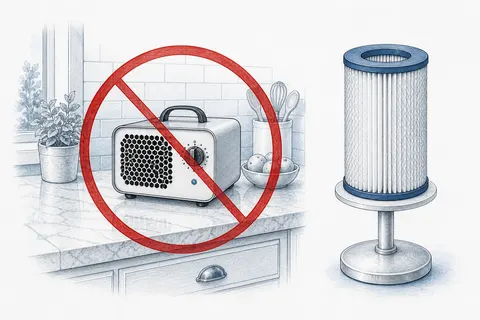
At-Home Ozone Therapy vs EBO2 (EBOO): What Regulators Say About Home Ozone Devices
What the FDA, EPA, FTC and Health Canada say about home ozone devices, the injuries on record by route, and why EBO2 (EBOO) is not a home procedure.

Does EBO2 (EBOO) Work? The Evidence, Study by Study
Every study in our EBO2 (EBOO) library in one place: design, size, what was measured and found, its limits, and a check for any study a clinic cites.

EBO2 (EBOO) Side Effects and Safety: What Studies, Case Reports, and Regulators Record
What the EBOO studies record about side effects, the harms documented with other ozone procedures, the risks of the circuit, and what regulators have found.