Clinics ·
Lafayette Clinic That Never Used Needles Adds EBO2, Its First Therapy With an IV
The Nerve Health Institute in Lafayette, Louisiana now offers EBO2. Its founder explains why, what a session is like and who is screened out.
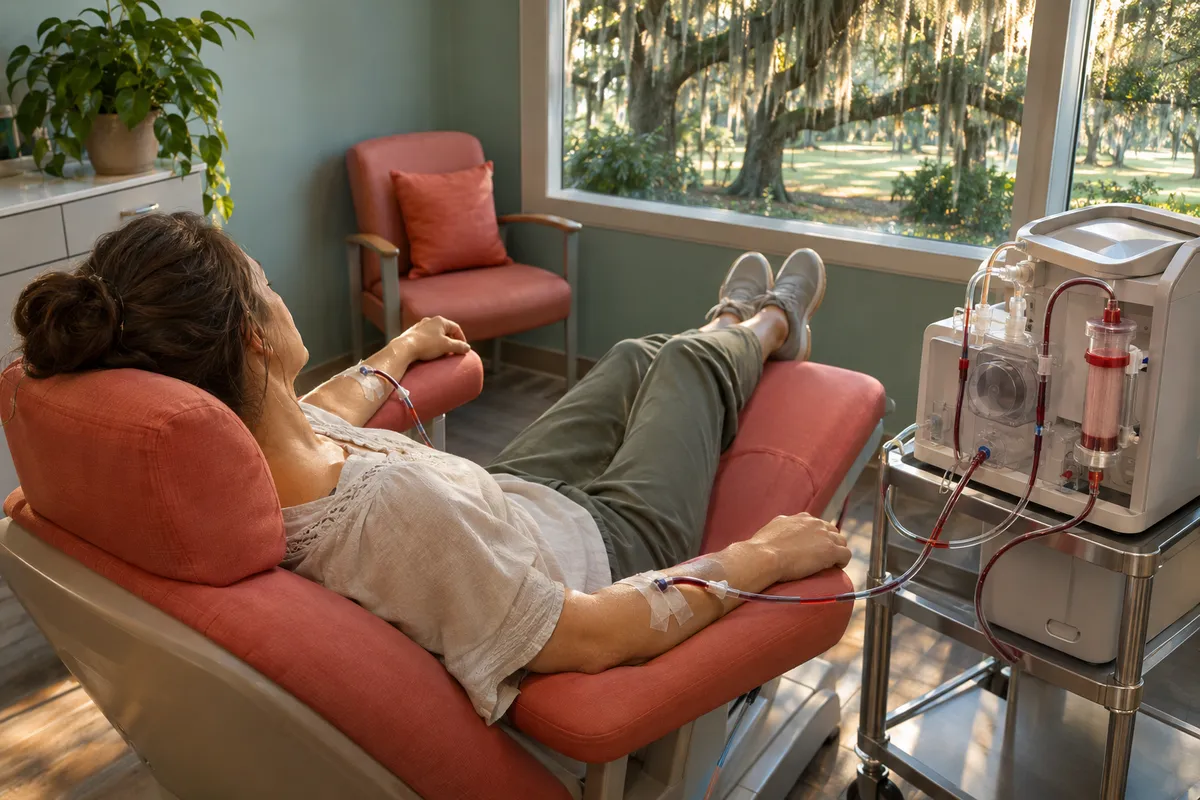
For decades, The Nerve Health Institute in Lafayette, Louisiana offered only care that never breaks the skin. That has now changed: the clinic has added EBO2 (also called EBOO), which uses an IV line in each arm. In October 2026 its founder, Dr. Chris Cormier, set out why the clinic made an exception for this one therapy, and his account gives a clear, practical picture of how EBO2 is run there.
This is one clinic’s description of its own service and the reasoning behind it. It is not a study and reports no measured results. Its value for readers is the detail on what happens during a session and how the clinic decides who should have one.
Why the clinic made room for it
Dr. Cormier says his approach has always been about supplying what the body runs on, in a set order: oxygen, water and light first, then frequency, magnetism and nutrients. He calls this the OWL Method. Over the years, he writes, he kept hitting the same wall. Putting good things in is only half of how the body works. The other half is clearing things out.
He notes that the kidneys, liver, lungs, skin and lymph already handle that job well, but argues they face a heavier workload in modern life, pointing to things nobody chooses, such as microplastics and the air along a busy road. That led him to add clearance as a seventh consideration next to the six he had always taught. He compares it to a cook clearing a crowded counter so good ingredients can go further. In his view EBO2 is not a replacement for the rest of his program or a shortcut around it, but a step meant to make the rest of the work easier.
He chose a therapy that works on the blood because blood is the body’s delivery network, carrying oxygen and nutrients out to the tissues and bringing waste back.
What a session looks like in Lafayette
The clinic runs EBO2 under the name EBOO Prime, as a separate service inside the practice, led by a nurse with 25 years of experience who also does all the screening. Dr. Cormier describes a visit this way:
- A session lasts about an hour, plus some time before and after.
- Patients sit in a chair chosen for comfort over a long sitting, with arms supported and legs raised.
- The nurse places one line in each arm: blood leaves through one and returns through the other in a continuous loop, passing a filter and an oxygen and ozone stage on the way.
- Patients can watch the loop the whole time, which he says most people find more reassuring than they expected.
- Each session handles about two liters of blood, out of roughly six in an average adult, so it is generally approached as a planned series rather than a single visit, and how often depends on the person and is talked through at the consultation.
He admits he is not fond of needles and was nervous before his own first session. It turned out to be a non-event, he says, and he found the hour restful.
Who it is for
The service is for adults only. Every prospective patient is checked by the nurse against a full list of reasons not to proceed, covering certain medical histories and conditions and the state of the arms and veins, and some people are told it is not a good fit. Dr. Cormier counts that willingness to say no as one of the best features of the service.
He is also clear about limits. He presents EBO2 as a supportive wellness therapy centered on circulation and oxygenation, not as care for a diagnosed disease and not a stand-in for treatment someone already receives. Sleep, breathing, hydration and light still matter most, he writes.
What it means if you are looking at EBO2
For people in the region, the main news is access. Dr. Cormier says the therapy is still hard to find in the United States and that people nearby often had to fly to get it. A local option makes it possible to fit sessions into an ongoing plan with the same team.
His account lines up with what to ask any provider: who places the lines, how screening works, and how many sessions they plan. Our guide to what to expect at a session covers a typical visit, who should not have EBO2 explains common screening questions, and the clinic directory lists providers by state, including Louisiana.