Research ·
New Study: Active Men Lasted Longer on the Treadmill After Ozone Blood Therapy
On average, 17 active men ran about a minute longer and rated the effort easier after 10 ozone blood therapy sessions, a 2026 study from Istanbul reports.
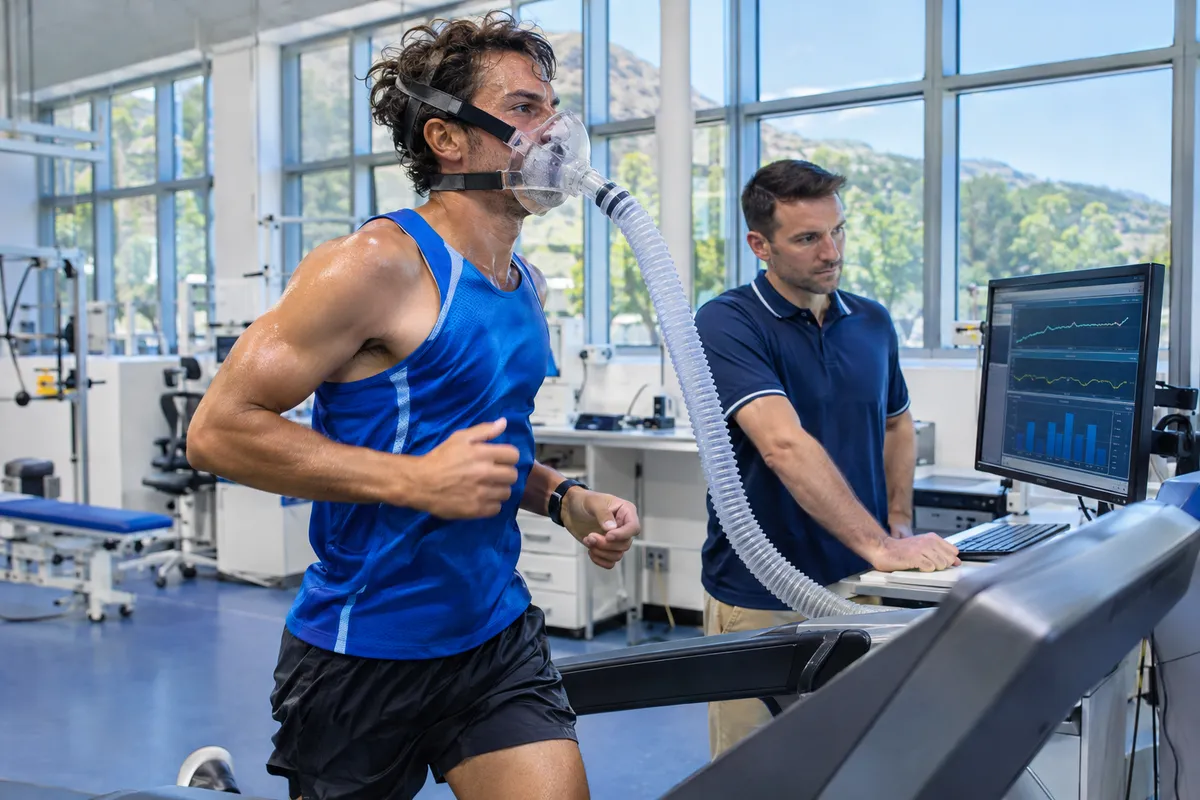
A sports medicine team at Istanbul University wanted to know what a course of ozone blood therapy does to exercise performance in healthy, active people. Their answer, published on November 13, 2026 in the journal Medicine, is encouraging: after 10 sessions over six weeks, the men in the study on average kept going longer on a treadmill test, reached a higher peak oxygen uptake and rated the effort as less tiring.
It is an early result, and the authors are careful about what it can and cannot show. Here is what they did and what they found.
What the researchers did
The team recruited healthy, physically active men and tested each of them twice, once before the course of ozone therapy and once after it. Twenty-one men started and seventeen finished both tests. The four who left had caught upper respiratory infections.
The test was a cardiopulmonary exercise test on a treadmill. The workload rises in three-minute stages and the runner keeps going as long as he can, while a metabolic device measures oxygen use breath by breath. The researchers also took blood lactate readings at the end of every stage, at the end of the test and during recovery, and asked each man to rate his fatigue from 0 to 10.
The therapy was major autohemotherapy, the classic form of ozone blood therapy. At each session, 100 mL of blood was drawn into a bottle, mixed with an oxygen and ozone gas at a low concentration, and returned through the same vein. Sessions were short, 15 to 20 minutes each. The men had one session a week for two weeks, then two a week for four weeks, and kept up their normal training the whole time. The team reports no complications during the treatments.
What changed after six weeks
Four measures improved between the first test and the second:
- Time on the test went up by about a minute on average (0.99 minutes).
- Peak oxygen uptake, known as VO2max and the standard measure of aerobic fitness, rose by 2.65 mL per kilogram per minute.
- Running speed at a fixed lactate level (4 mmol/L), a marker of endurance, rose by about 1 km/h.
- Perceived fatigue fell by 2.35 points on the 10-point scale.
Lactate readings at some of the earlier stages were lower too, but that difference did not hold up once the statistics were corrected for the number of comparisons. Lactate at the end of the test and during recovery did not change.
Why the authors call it preliminary
There was no comparison group. Every man had the therapy, kept training, and took the same hard test a second time, and people can do better on a repeat test simply because they know what is coming. The authors say placebo and learning effects cannot be ruled out, that seventeen men is a small group, and that the results cannot be assumed to hold for women. They call for randomized controlled trials to confirm the findings.
They also add a note for competitive athletes. World anti-doping rules prohibit taking blood out and returning it to the circulation, at all times. The study set out to describe how the body responds, and the authors say it should not be read as support for using the therapy as a performance aid.
What it means if you are looking at EBO2
The study used major autohemotherapy. EBO2 (also called EBOO) is a different way of doing the same basic thing: blood flows continuously from one arm through a filter, where it meets oxygen and ozone, and back through the other arm. This study did not test EBO2, and results from one method do not automatically carry over to the other.
What it adds is a careful early look at ozone blood therapy in healthy, active people, a group the authors say has been little studied. If stamina and recovery are why you are interested, our guide to EBO2 for athletes covers what clinics offer and what the research says so far, and EBO2 vs 10-pass ozone explains how the methods differ. When you are ready to talk to a clinic, the clinic directory lists them by state.